

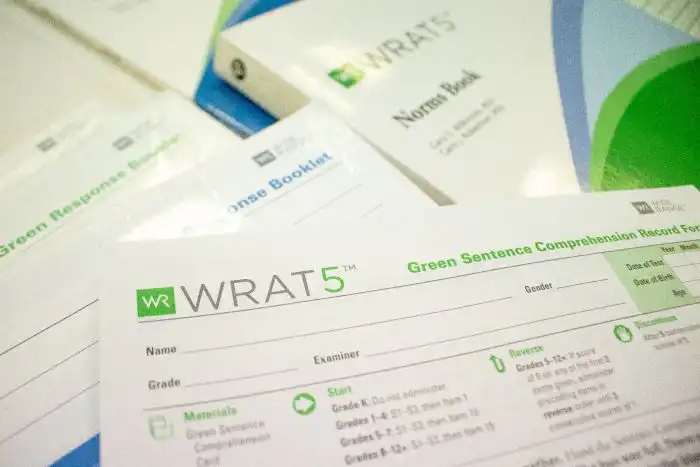
The Wide Range Achievement Test 5 (WRAT5)
The 2017 release of the Wide Range Achievement Test 5 (WRAT5), authored by Gary S. Wilkinson and Gary J. Robertson, marked a significant milestone. Published by Pearson, the WRAT5 is not just a minor update; it is a full re-standardization of the previous WRAT4. While the core structure remains familiar, the administrative and scoring modifications are substantial.
Whether you are assessing a child for school support or an adult for Higher Education (H.E.) funding, understanding the nuances of the WRAT5 is essential. This guide explores the structure, advantages, and critical cautions of the WRAT5, including its vital role in testing for dyslexia.
What is the WRAT5?
The WRAT5 is a norm-referenced achievement test designed to measure the foundational academic skills of individuals aged 5 to 85+ years. It provides a quick and reliable way to assess reading, spelling, and math skills, making it an ideal choice for both initial screenings and comprehensive diagnostic batteries.
The Four Core Sub-tests
The WRAT5 is composed of four primary sub-tests that target the building blocks of academic success:
- Word Reading: This sub-test measures single-word reading accuracy, focusing on the individual’s ability to decode letters into sounds and recognize words on sight.
- Sentence Comprehension: Moving beyond single words, this measures the ability to understand the meaning of sentences through a “cloze” procedure (filling in missing words).
- Spelling: This assesses the ability to encode sounds into written form through single-word spelling.
- Math Computation: This focuses on foundational mathematical calculations, ranging from basic counting and oral math to complex written equations.
The New Reading Composite
A major addition to the WRAT5 is the Reading Composite score. This score is derived by combining the results of the Word Reading and Sentence Comprehension sub-tests. While this provides a more holistic view of “reading ability,” the SpLD Test Evaluation Committee (STEC) advises caution. Assessors must carefully interpret what this combined score represents for an individual, particularly if there is a significant discrepancy between their decoding (Word Reading) and their understanding (Comprehension).
Why the WRAT5 Matters for Dyslexia Testing
When assessing for Specific Learning Difficulties (SpLD) such as Dyslexia, the WRAT5 is a powerhouse tool. Dyslexia is primarily characterized by difficulties with accurate and/or fluent word recognition and by poor spelling and decoding abilities.
Identifying the “Signature” of Dyslexia
The WRAT5 targets the exact areas where individuals with dyslexia typically struggle:
- Phonological Processing & Decoding: The Word Reading sub-test highlights difficulties in mapping graphemes (letters) to phonemes (sounds).
- Encoding Deficits: The Spelling sub-test often reveals the “persistent” nature of spelling difficulties, even in high-functioning adults.
- The Discrepancy Model: While the “discrepancy model” (comparing IQ to achievement) is no longer the sole way to diagnose, the WRAT5 allows assessors to compare academic achievement against cognitive ability (using tests like the WASI-II). A significant “dip” in Word Reading and Spelling relative to general intelligence is a classic indicator of dyslexia.
Clinical Sub-groups
The WRAT5 manual includes data on specific clinical sub-groups, including those with Reading Disorders. This allows assessors to see how a student’s profile compares to others with a confirmed diagnosis, aiding in a more confident and evidence-based differential diagnosis.
Key Advantages of the WRAT5
Why should assessors upgrade from the WRAT4? The improvements go beyond just new norms.
1. Robust Re-standardization
Achievement tests rely on contemporary data. The WRAT5 was re-standardized between 2016 and 2017, providing current norms that reflect the modern educational landscape. This ensures that the “Standard Score” an individual receives is an accurate reflection of their performance compared to their current peers.
2. Reduced Cultural Bias
The authors made a concerted effort to minimize culturally specific content. While some “Americanisms” remain (such as specific math topics like logarithms which are introduced at different stages in the UK vs the US), the language used is more inclusive and accessible globally.
3. Support for EAL Learners
For the first time, the manual includes guidance on English as an Additional Language (EAL). It provides a framework for how to account for dialectal differences or linguistic patterns when scoring reading, ensuring that a “mispronunciation” based on a primary language isn’t unfairly penalized as a reading error.
Critical Administrative Cautions
While the WRAT5 is improved, it is also more “sensitive” to how it is administered. Assessors must be aware of several changes that could impact the results, particularly for adult learners.
The “Five-Error” Discontinue Rule
In previous versions, an assessor might wait for 10 errors before stopping. The WRAT5 has reduced this to five consecutive errors for Word Reading, Spelling, and Math.
- The Risk: For some adults, this may lead to an underestimation of their true ability. If they have a “patchy” knowledge base (common in dyslexia), they might miss five hard words but be able to get the sixth or seventh correct. Assessors should use qualitative reporting to note if they believe the score doesn’t fully represent the individual’s ceiling.
Increased Reading Load for Adults
The routing procedure for Sentence Comprehension has changed. Previously, an individual’s Word Reading score determined where they started. Now, all adults start at Item 15. This can result in an adult in Higher Education reading up to 35 sentences. For those with reading fatigue, this increased volume can impact their performance toward the end of the test.
Comparison Table: WRAT4 vs. WRAT5
| Feature | WRAT4 | WRAT5 |
| Discontinue Rule | 10 or 7 consecutive errors | 5 consecutive errors |
| Reading Composite | Not available | New Reading Composite score |
| Adult Start Point | Based on Word Reading | Fixed start at Item 15 |
| EAL Guidance | Minimal | Specific scoring considerations included |
| Standardization | 2006 | 2017 (Current) |
Scoring and Presentation Nuances
Assessors should prepare for a few practical shifts in the testing environment:
- Visual Clarity: The stimulus cards are printed in a lighter typeface than previous versions, which may be a hurdle for individuals with visual processing issues.
- Confidence Intervals: These are no longer in a simple look-up table. Assessors must calculate them individually using the levels provided at the bottom of the norms tables.
- Math Working Paper: It is now a requirement to provide a separate blank sheet of paper for math working, rather than just using the margins of the response form.
Conclusion: The Path to a Diagnostic Assessment
The Wide Range Achievement Test 5 (WRAT5) is a sophisticated and necessary update to a classic tool. Its ability to provide quick, normed data on core academic skills makes it indispensable for identifying SpLDs and informing educational support. However, its utility is entirely dependent on the assessor’s scrupulous adherence to the new protocols—particularly the revised discontinue rules and the Sentence Comprehension routing.
It is important to remember that the WRAT5 is typically used as part of a formal diagnostic assessment. Because a full diagnostic assessment can be a significant investment of time and resources, it is often best practice to conduct a dyslexia screening test first. A screening can identify “at-risk” markers and help determine if a full evaluation using the WRAT5 is the necessary next step for the individual.
By combining modern norms with a deep understanding of administrative nuances, the WRAT5 remains one of the most powerful tools for helping learners unlock their potential.
I