

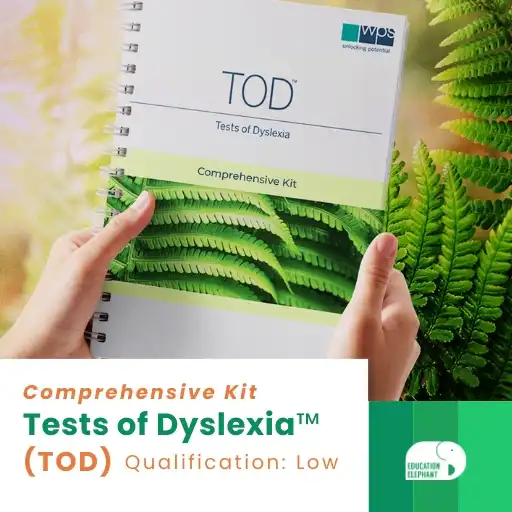
The Tests of Dyslexia (TOD) Dyslexia Assessment
Enter the Tests of Dyslexia (TOD) Comprehensive Assessment Suite. Published by Western Psychological Services (WPS) and developed by leading experts Nancy Mather, R. Steve McCallum, Sherry Mee Bell, and Barbara J. Wendling, the TOD is rapidly becoming the gold standard for identification and intervention across the lifespan.
Why a New Standard is Necessary
Historically, many dyslexia assessments relied on “discrepancy models”—waiting for a child to fall significantly behind their peers before providing help. This “wait-to-fail” approach is being replaced by a more proactive model. The TOD suite was standardized between 2019 and 2021, ensuring the norms reflect modern educational environments and diverse populations.
By covering individuals from age 5 to age 89, the TOD acknowledges that dyslexia isn’t just a “childhood issue”—it is a lifelong condition that requires different types of support at different stages of life.
The Three Pillars of the TOD Framework
What makes the TOD unique is its conceptual framework. Rather than just testing reading, it evaluates three “pillars” that provide a 360-degree view of a learner’s profile:
1. Reading and Spelling Domain
This is the “surface level” where dyslexia is most visible. The TOD measures:
- Phonics Knowledge: Can the person map sounds to letters?
- Decoding Efficiency: How quickly can they read “nonsense” or pseudowords?
- Reading Fluency: Can they read connected text with speed and accuracy?
- Spelling: Assessing orthographic memory and phonemic awareness through writing.
2. Linguistic Processing Domain
This domain looks under the hood at the brain’s “processing engine.” Weaknesses here are often the root cause of dyslexia.
- Phonological Awareness: The ability to manipulate sounds in spoken language.
- Rapid Automatized Naming (RAN): The speed at which one can name letters, numbers, or objects—a major predictor of reading fluency.
- Auditory Working Memory: Holding and manipulating sounds in the mind.
3. Vocabulary and Reasoning Domain
This is perhaps the most innovative part of the TOD. By measuring cognitive abilities that don’t require reading (like analogies and visual reasoning), evaluators can see if a student’s reading struggles are “unexpected.” This is crucial for Twice-Exceptional (2e) individuals—high-ability learners whose intelligence often masks their underlying reading disability.
Exploring the TOD Suite: Screener, Early, and Comprehensive
The TOD is not a single test, but a modular system that allows clinicians to be efficient with their time.
TOD-Screener (TOD-S)
- Duration: 10–15 minutes.
- Delivery: Can be administered to individuals or whole groups.
- Outcome: Provides a Dyslexia Risk Index (DRI). The screener is an ideal tool for schools looking for a universal screening solution to identify “at-risk” students early without performing a full diagnostic battery on everyone.
TOD-Early (TOD-E)
- Ages: 5:0 to 9:3 (Grades K–2).
- Focus: Pre-reading and foundational skills.
- Outcome: The Early Dyslexia Diagnostic Index (EDDI). Since many children in this age range cannot yet read connected text, the TOD-E focuses on rhyming, segmenting, and letter-word choice to catch signs of dyslexia before reading failure occurs.
TOD-Comprehensive (TOD-C)
- Ages: 6:0 to 89:11.
- Focus: Deep diagnostic evaluation.
- Outcome: The Dyslexia Diagnostic Index (DDI). This is the a tool for a formal diagnosis. It includes 20 subtests, but clinicians can select the most relevant ones to confirm a suspected profile, usually taking between 30 to 90 minutes depending on the complexity of the case.
Where to Purchase the TOD Assessment
The TOD suite is available through authorized psychological and educational publishers. Because it is a high-stakes diagnostic tool, it is generally sold through specialized portals.
- Primary Publisher: WPS (Western Psychological Services) is the lead publisher. They offer print kits, digital kits, and “combination kits” that include all three batteries.
- International Distributors: In the UK and Europe, the TOD is often available via Pearson Clinical or specialized distributors like Ann Arbor Publishers and The Dyslexia Shop.
- Estimated Costs: Prices vary by region and kit type, but a complete TOD Combination Kit (including Screener, Early, and Comprehensive components) typically ranges from £900 to £1,200. Individual screener kits are significantly more affordable, often starting around £350.
Qualification Requirements: Who Can Buy and Administer the TOD?
The TOD is classified as a Level B assessment. This means it is not available for purchase by the general public (parents or caregivers) to prevent “coaching” and ensure that results are interpreted by trained professionals.
Required Qualifications
To purchase or administer the TOD-E or TOD-C, an individual must typically meet one of the following criteria:
- Educational Requirements: A Master’s degree or higher in psychology, education, speech-language pathology, occupational therapy, or a related field.
- Professional Certification: Being a Certified Academic Language Therapist (CALT), Educational Diagnostician, or School Psychologist.
- Training: Formal training in the administration and interpretation of standardized, norm-referenced psychological tests.
While a classroom teacher might administer the TOD-Screener (with proper supervision), the TOD-C (Comprehensive) requires a professional with advanced coursework to interpret the statistical significance of the scores and provide a clinical diagnosis.
From Diagnosis to Action: The Intervention Companion
One of the biggest frustrations in assessment is getting a report that lists scores but doesn’t tell you what to do. The TOD solves this with the Dyslexia Interventions and Recommendations Companion Guide.
When you score the TOD through the WPS Online Evaluation System, the software helps generate an Intervention Report. This report maps the learner’s specific weaknesses (e.g., poor orthographic processing) to evidence-based teaching strategies. This bridges the gap between the psychologist’s office and the classroom, ensuring the assessment leads directly to student growth.
Final Summary
The TOD Suite represents a achievement in the field of learning disabilities. By combining modern psychometrics with a lifespan-focused approach and a clear path to intervention, it empowers professionals to change the narrative for individuals with dyslexia.
Whether you are a school district looking for a better screening process or a private clinician needing a robust diagnostic tool, the TOD offers a contemporary, reliable, and deeply insightful solution.