

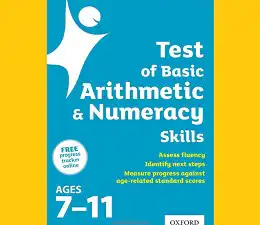
A Deep Dive into the TOBANS for Students with Dyslexia
Research suggests a high comorbidity between dyslexia and mathematical difficulties, often referred to as mathematical learning difficulties (MLD) or, in more specific cases, developmental dyscalculia. For an educator or specialist assessor, identifying exactly where a student’s “number sense” is breaking down is crucial.
This is where the Test of Basic Arithmetic & Numeracy Skills (TOBANS) comes into play. Authored by S. Brigstocke, K. Moll, and C. Hulme (2016), and published by Oxford University Press, the TOBANS is a powerhouse of diagnostic utility—provided you know how to interpret its findings through the lens of a dyslexic profile.
Why Dyslexia Impacts Arithmetic: The Fluency Gap
To understand why the TOBANS is so relevant to dyslexia, we must first look at the cognitive overlap. Dyslexia is frequently associated with deficits in rapid automatized naming (RAN) and working memory. In mathematics, these deficits manifest as a failure to achieve “arithmetic fluency.”
While a student with dyslexia may understand the concept of addition, they often struggle to retrieve basic number facts from long-term memory. They may rely on finger counting long after their peers have moved to automatic retrieval. The TOBANS is specifically designed to measure this automaticity and processing speed, making it a vital tool for uncovering the hidden arithmetic struggles of dyslexic learners.
Deconstructing the TOBANS Architecture
The TOBANS is a brief battery, taking only 15–20 minutes to administer. This brevity is a significant advantage for students with dyslexia, who often experience “test fatigue” or high levels of anxiety when faced with lengthy, literacy-heavy assessments.
1. The Arithmetic Fluency Subtests
The heart of the TOBANS consists of five separate, one-minute modules. Because they are timed so strictly, they bypass a student’s ability to “reason” their way through and instead capture their true level of fluency.
- Addition and Subtraction (Within 10): Measures basic retrieval.
- Addition and Subtraction (With Carry/Bridging 10): This is where many dyslexic students falter. The “bridging ten” process requires significant working memory—an area where dyslexic learners are often vulnerable.
- Multiplication: Assesses the retrieval of core single-digit facts.
2. Basic Number Processing
This section moves away from calculation and looks at foundational “number sense” through 30-second tasks:
- Digit Comparison: Symbolic number sense.
- Dot Comparison: Non-symbolic magnitude comparison.
- Count the Dots: Enumeration skill and pattern spotting.
The Diagnostic Power: Identifying the “Bridging” Breakdown
One of the most valuable features of the TOBANS for a dyslexia-focused assessment is the comparison between “within ten” and “bridging ten” tasks.
For a student with dyslexia, the cognitive load increases exponentially when a calculation requires regrouping (e.g., 8 + 7). They must hold the number 8 in their mind, decompose 7 into 2 and 5, add the 2 to make 10, and then add the remaining 5. For a brain already taxed by working memory deficits, this is the point of “cognitive overload.”
The TOBANS provides the hard data to show that a student isn’t just “bad at maths,” but rather that their processing speed and working memory are impeding their ability to bridge tens. This distinction is vital for creating an Effective Education Plan (EEP) or choosing the right intervention.
Practical Strengths for Educators
The TOBANS was standardised on UK school children and aligns perfectly with the UK national curriculum. For busy SENCOs (Special Educational Needs Coordinators), its practical benefits are numerous:
- Group Screening: It can be administered to up to four students at once, making it a cost-effective way to flag students who may need more intensive, one-to-one dyslexia/dyscalculia screening.
- Progress Tracking: With photocopiable sheets and online trackers, it is an excellent tool for pre- and post-intervention measurement. Did that six-week “Numicon” intervention actually increase their calculation speed? The TOBANS will tell you.
- Non-Threatening: Because it’s fast and focuses on simple numbers, it often feels less intimidating than a full-scale educational psychology assessment.
Navigating the Limitations: A Word of Caution
While the TOBANS is a brilliant conceptual tool, it is not without its hurdles in the current educational climate.
1. The Accessibility Crisis
The most glaring issue is that the TOBANS manual is out of print. For new assessors, this makes the tool difficult to adopt. Without the official manual, interpreting the theoretical grounding of the scores becomes a challenge.
2. The “Motor Skills” Variable
Students with dyslexia frequently have co-occurring dyspraxia or fine motor difficulties. Because the TOBANS is a paper-based, timed test that requires turning pages and writing quickly, a low score might reflect slow handwriting rather than slow mathematical processing. An observant assessor must note if a student is struggling with the physical act of the test rather than the sums themselves.
3. The “Guessing” Factor in Dot Comparison
Psychometrically, the Dot Comparison subtest has faced criticism. The 50/50 choice mechanism means students often guess, leading to “noisy” data. Educators should treat these specific scores with caution and corroborate them with qualitative observations of how the student handles concrete manipulatives.
How to Use TOBANS Results for Dyslexia Intervention
If the TOBANS reveals a significant gap in arithmetic fluency, what are the next steps for a student with dyslexia?
- Reduce Working Memory Load: Allow the use of number lines, 100-squares, or calculators for complex problems so the student can focus on the logic of the maths rather than the retrieval of the facts.
- Explicit Instruction in Subitising: Use the “Count the Dots” insights to teach the student how to “see” numbers in groups (e.g., seeing five dots as a group of 3 and 2) rather than counting every dot individually.
- Fact Fluency Software: Use targeted, short-burst digital interventions that focus specifically on the “bridging ten” skills identified as weak by the TOBANS.
- Multi-Sensory Maths: Just as we use multi-sensory approaches for reading, use physical objects (like Cuisenaire rods) to make the abstract “carrying” and “borrowing” processes visible and tactile.
Final Thoughts
The Test of Basic Arithmetic & Numeracy Skills (TOBANS) remains a vital, albeit increasingly rare, tool in the diagnostic kit. For the dyslexic learner, it peels back the layers of mathematical struggle, showing that the issue is often not a lack of mathematical logic, but a bottleneck in fluency and processing.
Despite its “slim” manual and out-of-print status, the TOBANS offers a window into a child’s numerical brain that few other quick assessments can match. By identifying exactly where the arithmetic breakdown occurs, we can move away from general “maths support” and toward the targeted, evidence-based interventions these students deserve.
Expert Tip: When using the TOBANS with a suspected dyslexic student, always record a “writing speed” observation. If their arithmetic fluency score is significantly lower than their writing speed suggests it should be, you have a clear indicator of a specific mathematical processing deficit.
Summary Table: TOBANS at a Glance
| Feature | Details |
| Age Range | 7:05 to 11:05 |
| Time to Administer | 15–20 minutes |
| Key Metric | Arithmetic Fluency (Speed & Accuracy) |
| Dyslexia Relevance | Highlights working memory and retrieval issues |
| Main Drawback | Manual is currently out of print |
| Best For | Screening and measuring intervention progress |