

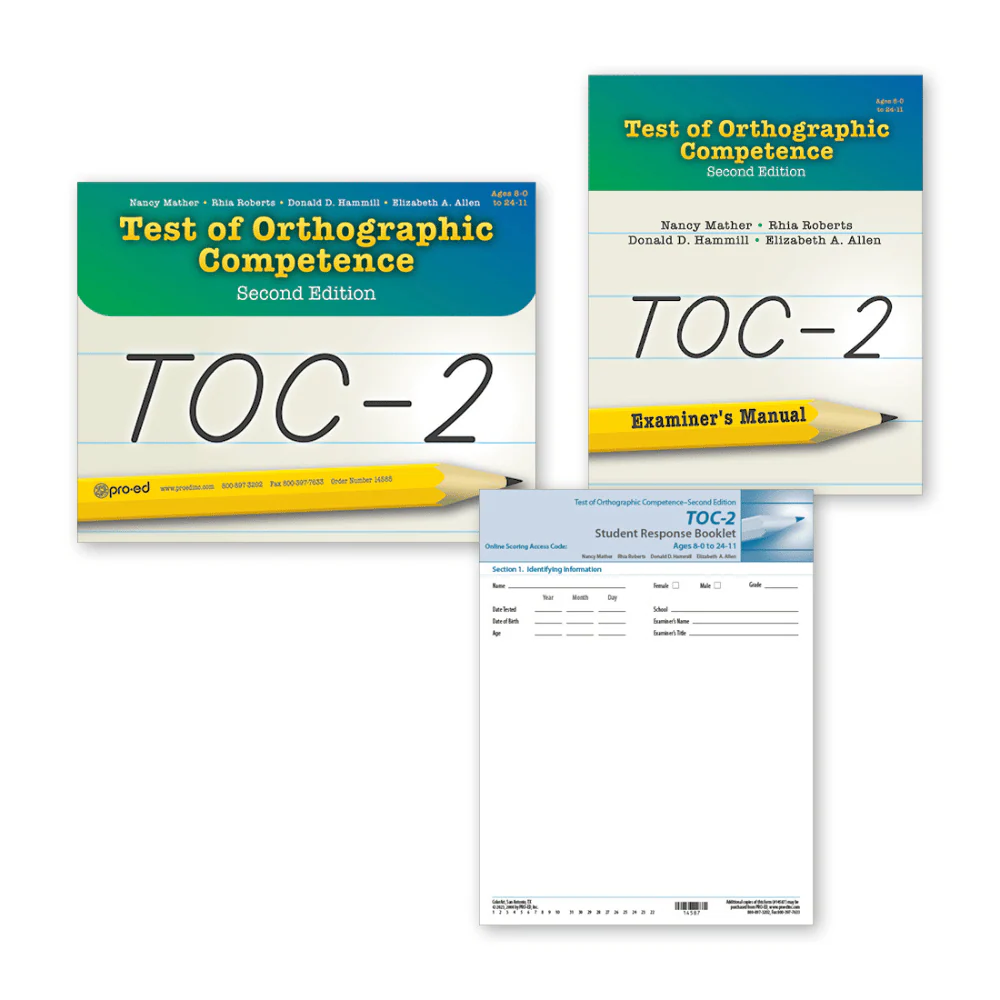
Test of Orthographic Competence, Second Edition (TOC 2) and Dyslexia
The Test of Orthographic Competence, Second Edition (TOC 2) is one such tool. Published by Pro-Ed and updated with standardization data from 2017–2020, it has become a cornerstone in the diagnostic toolkit for educators and psychologists. In this review, we explore how the TOC 2 provides a multifaceted view of dyslexia and why its nuanced approach is essential for modern diagnostic assessments.
What is Orthographic Competence?
Before diving into the test itself, it is vital to understand why orthographic competence is the “missing piece” for many dyslexia diagnoses. While dyslexia is primarily recognized as a phonological (sound-based) deficit, orthographic processing is the ability to acquire, store, and use mental images of words and letter patterns.
A student with dyslexia might be able to sound out a word (phonology) but still struggle to recognize that “laugh” is not spelled “laf.” This is a failure of the Mental Graphemic Representation (MGR). The TOC 2 is specifically designed to measure these internal word maps.
The Architecture of the TOC 2: Six Subtests
The TOC 2 covers a wide age range (8 years to 24 years, 11 months) and takes approximately 30–40 minutes to administer. Its power lies in its six distinct subtests, each revealing a different facet of how a dyslexic brain handles text.
1. Punctuation (Untimed)
This subtest measures a student’s grasp of orthographic conventions. Students must edit sentences that lack punctuation. For those with dyslexia, the cognitive load of spelling often “crowds out” the ability to apply grammatical marks, making this an essential measure of functional writing.
2. Abbreviations (Untimed)
This task asks students to write the meanings of common abbreviations. It assesses the recognition of conventional written forms that don’t always follow standard phonetic rules.
3. Sight Spelling (Untimed)
This is a direct window into the student’s stored mental images of words. By filling in missing letters in words—many of which are irregular—students demonstrate whether they have built a reliable internal dictionary or if they are still over-relying on “sounding out” words.
4. Homophone Spelling (Untimed)
Dyslexia often manifests as a “semantic-orthographic” disconnect. A student might know how to spell there, their, and they’re, but cannot choose the right one in context. This subtest uses pictures to ensure the student can map the correct spelling to the correct meaning.
5. Word Scramble (Timed – 3 Minutes)
This is a high-pressure measure of spelling fluency. Students must rearrange scrambled letters to form real words. It tests the ability to mentally manipulate orthographic patterns quickly—a common area of weakness in dyslexic learners.
6. Letter Choice (Timed – 2 Minutes)
Perhaps the most “classic” dyslexia-related task, this involves 160 items where the student must select the correct orientation of common letter reversals (p, d, b, or q) to complete a word. It measures the automaticity of letter-form knowledge.
The Power of Composite Scores
The TOC 2 doesn’t just give a “pass/fail” on spelling. It synthesizes these subtests into five composite scores that provide a diagnostic profile:
- Conventions: (Punctuation + Abbreviations) – Knowledge of the mechanics of English.
- Spelling Accuracy: (Sight Spelling + Homophone Spelling) – The quality of stored word images.
- Spelling Fluency: (Word Scramble + Letter Choice) – The speed of retrieval and manipulation.
- Spelling Efficiency: A weighted composite specifically designed to measure orthographic processing. This is often the “smoking gun” in a dyslexia assessment.
- Orthographic Knowledge: The “big picture” score, incorporating all six subtests.
Why the TOC 2 is a Game-Changer for Dyslexia Professionals
1. Robust Standardization
With a sample size of 1,512, the TOC 2 offers credible, reliable Standard Scores. For an assessor, this means the data holds up under the scrutiny of a Full Diagnostic Assessment.
2. Identification of “Stealth Dyslexia”
Some students—particularly high-ability or “twice-exceptional” learners—can compensate for phonological weaknesses but still struggle with orthographic fluency. The timed subtests (Word Scramble and Letter Choice) often reveal the underlying processing delays that untimed spelling tests miss.
3. Support for Access Arrangements
In the UK, the TOC 2 is recognized by SASC (SpLD Assessment Standards Committee). Data from the fluency and efficiency composites can be used to support applications for Examination Access Arrangements (such as 25% extra time) by providing evidence of slow cognitive processing and writing fluency.
Practical Considerations and Limitations
No test is perfect, and the TOC 2 requires a skilled clinician to interpret the results accurately.
The “Americanisation” Factor
The TOC 2 is an American publication. For UK-based students, the Abbreviations subtest can be problematic. Certain abbreviations common in the US may be unfamiliar to a British student. The SASC guidance recommends that UK assessors interpret this subtest qualitatively rather than relying solely on the raw numerical score. If the Abbreviations score looks like an outlier, the Conventions composite should be viewed with caution.
The Cost of Online Scoring
A notable shift in the second edition is the requirement for mandatory online scoring. While this ensures accuracy and saves time, it involves a “pay-per-use” model. The initial kit includes 25 entries, but subsequent uses require purchasing more credits. This is an ongoing financial factor for schools and independent practices to consider.
Basals and Ceilings
While the Sight Spelling and Homophone Spelling subtests have “basals” and “ceilings” (rules for when to start and stop), the other four subtests do not. This means every student, regardless of age, starts at item one. For older, high-functioning students, this can feel repetitive and may slightly lengthen the administration time.
Virtual Testing Warnings
While remote learning and assessment grew during the 2020s, the TOC 2 was not normed for virtual administration. Assessing a student over Zoom or Teams adds complexity—such as ensuring the student doesn’t open the sealed response booklet early—and may compromise the validity of the scores.
The Verdict: A Vital Tool for Dyslexia Diagnosis
The Test of Orthographic Competence, Second Edition (TOC 2) is far more than a spelling test. It is a sophisticated instrument that dissects the mechanics of written language. By looking at accuracy, fluency, and conventions separately, it allows assessors to pinpoint exactly where the “breakdown” is occurring for a student with dyslexia.
For the student, this means a more accurate diagnosis. For the teacher, it means more targeted interventions—focusing perhaps on orthographic “mapping” rather than just phonics. Despite the minor hurdles of cultural bias in abbreviations and the costs of online scoring, the TOC 2 remains a premier choice for understanding the dyslexic profile in 2026 and beyond.
Summary Table: TOC 2 at a Glance
| Feature | Details |
| Age Range | 8:0 to 24:11 |
| Administration Time | 30–40 Minutes |
| Core Focus | Orthographic Processing & Spelling Fluency |
| Key Advantage | Measures “efficiency” and “fluency,” not just accuracy |
| Key Limitation | US-centric abbreviations; online scoring fees |
| SASC Status | Approved for SpLD/Dyslexia Diagnostic Assessments |
Assessor Tip: Always pair the TOC 2 with a measure of phonological awareness (like the CTOPP-2) to get the full picture of the “double deficit” often seen in severe dyslexia.