

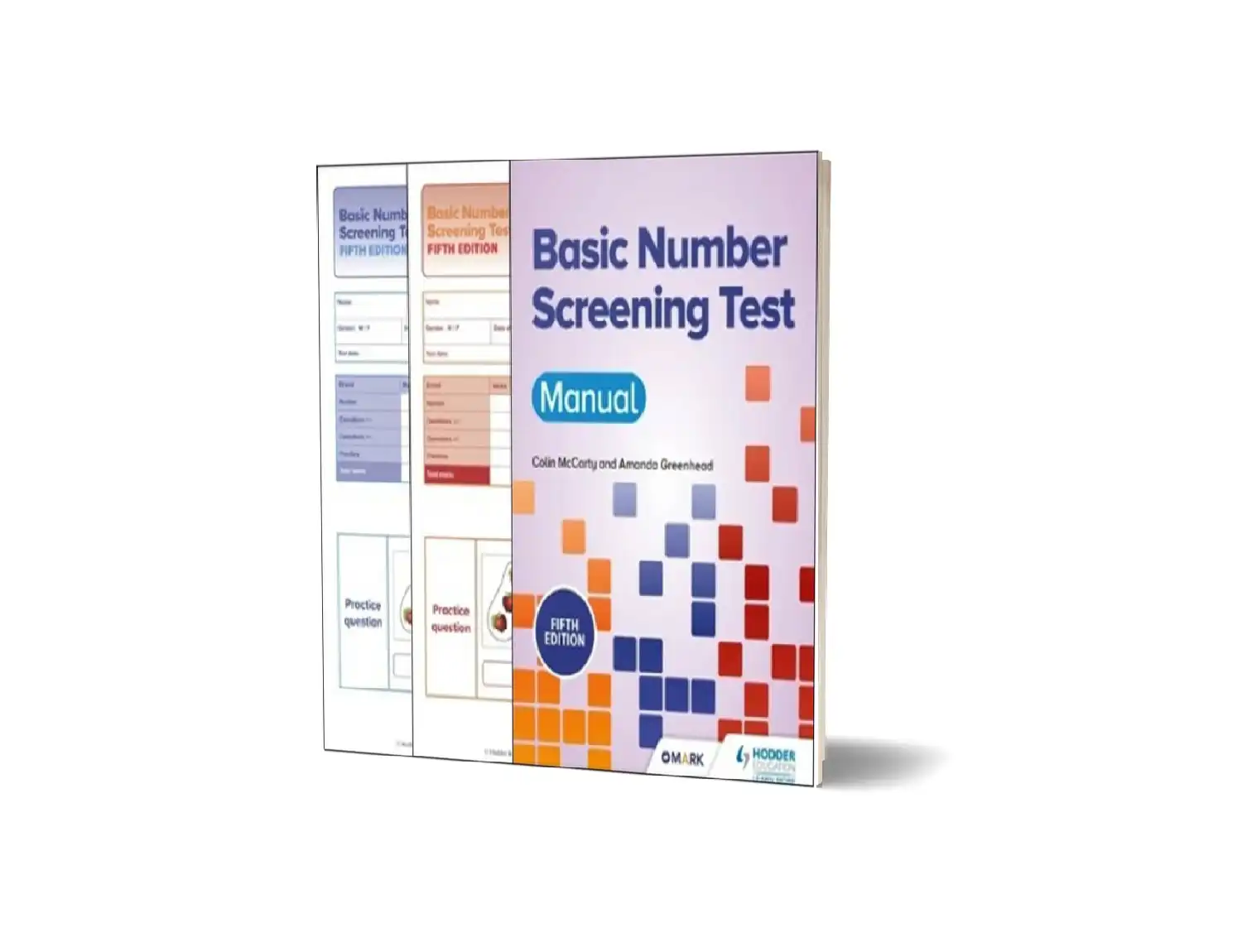
The Basic Number Screening Test (BNST)
If a child or adult with dyslexia is struggling with numbers, it isn’t necessarily because they have dyscalculia (a specific learning difficulty explicitly rooted in number sense). Often, the breakdown happens because mathematics relies on sequential processing, working memory, and language the exact cognitive foundations that dyslexia disrupts.
To support individuals effectively, educators need tools that can separate a student’s mathematical capability from their reading hurdles. This is where the Basic Number Screening Test (BNST) 5th Edition becomes invaluable.
In this comprehensive guide, we will explore the intersection of dyslexia and maths, unpack how the BNST serves as a unique assessment tool, and guide you on the crucial first steps to take if you suspect you or your child has dyslexia.
The Hidden Link: Why Does Dyslexia Affect Maths?
It is a common misconception that mathematics is a purely visual or logical subject completely separate from language. In reality, math is a language of its own. Individuals with dyslexia face a unique set of challenges when encountering mathematical concepts:
- Working Memory Deficits: Retaining a series of spoken instructions or holding numbers in mind while executing a multi-step calculation (like long division) can quickly overload a dyslexic learner’s working memory.
- Directional Confusion: Dyslexia often co-occurs with left-right confusion or spatial orientation issues. This makes concepts like reading a number line, navigating columns in grid multiplication, or keeping track of decimal places exceedingly difficult.
- Sequencing Difficulties: Remembering the specific sequence of steps required to solve an equation, or even memorizing the sequential order of times tables, presents a major cognitive roadblock.
- Word Problems: Interpreting the linguistic narrative of a word problem translating words like “minus,” “difference,” or “share” into math symbols creates an immediate literacy barrier before the math calculation even begins.
Introducing the Basic Number Screening Test (BNST) 5th Edition
To properly support a dyslexic learner who is struggling with mathematics, educators need an accurate baseline of their math skills that won’t be skewed by their reading difficulties.
The Basic Number Screening Test (BNST) 5th Edition, recently reviewed by the SpLD Test Evaluation Committee (STEC) in May 2026, is a highly effective instrument for this exact purpose. Authored by C. McCarty and A. Greenhead (adapting the original work of B. Gillham and K. Hesse), this updated screening tool evaluates standard mathematical attainment across a wide age range.
Key Specifications of the BNST (5th Edition):
- Age Range: 5 years and 7 months to 14 years and 11 months (5:07 – 14:11), extending up to Key Stage 3 (KS3).
- Administration Time: Quick and non-invasive, taking roughly 30 minutes for a 1:1 session or 40 minutes for group settings.
- Test Formats: Features parallel pupil response booklets (Form A and Form B). The instructions and scripts are identical, allowing teachers to alternate papers between side-by-side students to prevent copying.
Why the BNST is a Game-Changer for Dyslexic Learners
The BNST is uniquely structured in a way that accommodates the cognitive profile of a student with dyslexia, making it an excellent resource for diagnostic tracking.
1. It Does Not Rely on Reading Ability
The most significant benefit of the BNST for dyslexic individuals is that instructions are given entirely verbally by the assessor. Because it does not rely on a student’s independent reading skills, a child with severe dyslexia can showcase their true mathematical comprehension without being penalized by their literacy difficulties.
2. Comprehensive, Targeted Mathematical Areas
Rather than focusing purely on abstract arithmetic, the test yields a singular overall score derived from three core pillars of the primary and lower secondary math curriculum:
- Number Concepts (36%): Testing foundational understanding of what numbers represent.
- Number Operations (44%): Assessing calculations, divided on the response form into helpful qualitative categories like +/- and times div.
- Fractions and Decimals (20%): Assessing proportional reasoning.
3. Clear Links to Educational Intervention
Every single question in the BNST is cross-referenced directly to the English National Curriculum year group content. This ensures that if a dyslexic student fails a specific cluster of questions, the teacher receives instant, actionable data to map out targeted math interventions.
4. Robust, Post-Pandemic Standardisation
The BNST was standardised using a sample of 8,962 pupils from 78 schools across England, Wales, and Scotland. Crucially, this standardisation took place in 2022 after schools returned to face-to-face teaching following COVID-19 disruptions. It also intentionally included an over-representation of Special Educational Needs (SEN) students (24% compared to the national 12% average), ensuring its scoring norms are highly realistic for diverse learning profiles.
A Quick Snapshot: BNST Features at a Glance
| Feature | Details & Specifications | Why it Matters for Dyslexia |
| Delivery Style | Verbally dictated script by assessor. | Eliminates the reading barrier completely. |
| Reliability Measures | Form A: 0.91; Form B: 0.92 (Cronbach’s Alpha). | Highly reliable, comparable test variants. |
| Lowered Score Floor | Standardised scores now extend down to 60 (previously 70). | Better tracks and measures progress for severely struggling students. |
| Ceiling Rule | Test stops if a pupil misses 3 successive questions. | Prevents cognitive fatigue and anxiety. |
Important Note on Diagnostics: It is essential to keep in mind that the BNST is an attainment screening tool designed to catch students struggling in maths. As explicitly highlighted by the STEC guidance, the test itself is not designed to formally diagnose specific learning difficulties (SpLDs) like dyslexia or dyscalculia. Instead, it highlights exactly where a student’s mathematical knowledge base is breaking down.
Think You Might Have Dyslexia? Here is Your Crucial First Step
If you or your child is struggling with mathematics, and you notice it is constantly paired with reading fatigue, slow processing, or difficulties with written organization, the underlying root cause may be dyslexia.
The single most empowering thing you can do is move away from guesswork and obtain clear answers. The vital first step is to get tested through a professional dyslexia screening test.
How a Screening Test Helps
A screening test is a preliminary assessment that looks at your cognitive strengths and weaknesses. It analyses phonological processing, rapid naming skills, working memory, and visual-spatial reasoning to identify the classic markers of dyslexia.
Moving Forward: Embracing a New Way of Learning
Dyslexia is not a reflection of intelligence; it is simply a reflection of how the brain is wired. When mathematical difficulties stem from a dyslexic profile, continuing to drill standard formulas or forcing a student to read dense math textbooks will only result in further frustration.
By utilizing verbal screening assessments like the Basic Number Screening Test, educators can successfully look past a student’s reading struggles to see what they are truly capable of in mathematics. Combined with an official dyslexia screening from a dedicated hub like the Indigo Dyslexia Centre, you can unlock the exact tools, interventions, and confidence needed to master both language and numbers on your own terms.