

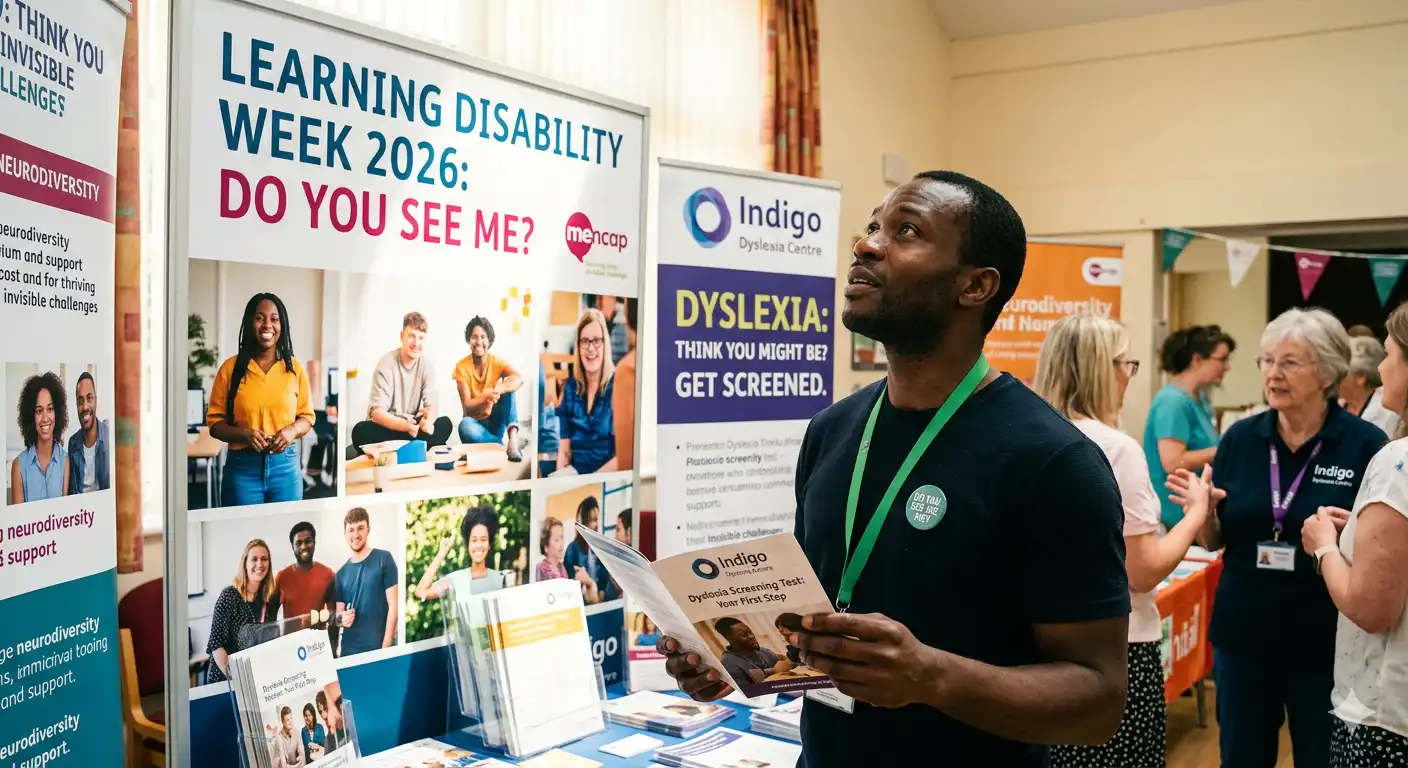
Celebrating Learning Disability Week 2026 and Rethinking Dyslexia
This year, Learning Disability Week 2026 runs from Monday 15th June to Sunday 21st June 2026.
The powerful official theme for 2026 is “Do you see me?” It is a poignant, urgent question. It challenges society to look past labels, outdated stereotypes, and systemic barriers. It asks us to truly see, hear, include, and value individuals for who they are. While learning disabilities encompass a wide range of intellectual and developmental conditions, this theme also resonates deeply with those who navigate life with “invisible” neurodivergent conditions.
Among these, dyslexia stands out as one of the most common yet widely misunderstood learning differences. For someone with dyslexia, the question “Do you see me?” often means asking society to see their true cognitive potential, rather than judging them by how fast they can read a block of text or spell a complex word.
In this comprehensive guide, we explore Learning Disability Week 2026 through the lens of dyslexia. We will look at what dyslexia really is, how it fits into the broader conversation about neurodiversity, and why getting a formal dyslexia screening test from professional providers like the Indigo Dyslexia Centre can completely transform a person’s life.
1. Understanding the Theme: “Do You See Me?”
The “Do you see me?” theme 2026 is about visibility, respect, and dignity. For decades, individuals with learning disabilities and neurodivergent profiles have faced severe social exclusion. Statistically, people with learning disabilities are heavily underrepresented in the workforce and frequently experience health and social inequalities.
When we apply the “Do you see me?” theme to dyslexia, it takes on an layered meaning. Dyslexia is often described as an invisible disability. On the outside, an individual may appear highly articulate, creative, and capable. Yet internally, they may be expending double or triple the cognitive energy of their peers just to process written text, keep up with a meeting agenda, or remember a sequence of verbal instructions.
Because their struggles are hidden, dyslexic individuals are frequently mischaracterized. Children are sometimes unfairly labelled as “lazy” or “not trying hard enough,” while adults may mask their difficulties out of fear of being deemed incompetent in the workplace.
Learning Disability Week 2026 demands that we unmask these hidden challenges. It asks us to look closely enough to see the hidden battles, but more importantly, to see the unique, brilliant brains behind them.
2. Learning Disabilities vs. Learning Difficulties: Clarifying Dyslexia
In the UK, there is an important clinical and social distinction between a learning disability and a specific learning difficulty (SpLD). Understanding this difference is essential for proper advocacy and support.
- Learning Disability: As defined by Mencap, a learning disability involves a reduced intellectual ability that affects an individual across their entire life. It impacts global cognitive functioning, making it harder to learn daily everyday skills, communicate independently, or manage complex tasks without ongoing support. Examples include Down’s syndrome or profound and multiple learning disabilities (PMLD).
- Specific Learning Difficulty (SpLD): Dyslexia falls into this category. An SpLD is a neurodevelopmental condition that affects specific areas of learning and information processing, but does not affect a person’s overall general intelligence. In fact, dyslexic individuals often have average or exceptionally high IQs.
Despite this technical distinction, dyslexia is heavily championed during Learning Disability Week because both groups share the same core struggle: fighting for reasonable adjustments in a world built for a rigid, neurotypical standard. Whether a condition is global or specific, the goal of this awareness week is to cultivate an inclusive society where everyone’s cognitive makeup is understood and accommodated.
3. What is Dyslexia? Moving Beyond “Backward Letters”
To truly see someone with dyslexia, we must dismantle the outdated myths surrounding the condition. The most pervasive myth is that dyslexia is simply a visual problem where people read letters backward or mix up “b” and “d”.
In reality, dyslexia is a neurological difference in how the brain processes language. It primarily impacts phonological processing the ability to identify, manipulate, and map the sounds of spoken language onto written symbols (letters).
Because the brain of a dyslexic individual takes an alternative, less direct neural pathway to decode words, reading takes significantly longer and requires conscious mental effort rather than occurring automatically.
The Hidden Strengths of Dyslexia
It is vital to recognize that the dyslexic brain is not “broken”; it is wired differently. While it struggles with sequential, linear tasks like spelling and rote memorization, it often excels in holistic, non-linear thinking. Many experts refer to this as the “Dyslexic Advantage,” which includes:
- Excellent Spatial Awareness: The ability to visualize objects and environments in 3D, making many dyslexics exceptional architects, engineers, and designers.
- Advanced Narrative Reasoning: A profound ability to connect disparate pieces of information, remember complex stories, and see the big picture.
- Creative Problem Solving: Because their brains do not follow standard linear tracks, dyslexic individuals are naturally innovative, frequently finding unique out-of-the-box solutions to problems.
- High Emotional Intelligence: Many neurodivergent individuals develop deep empathy, resilience, and strong interpersonal communication skills due to navigating a world that isn’t built for them.
4. Recognizing the Signs of Dyslexia Across Different Ages
Dyslexia is a lifelong condition, but its manifestations change over time. Early identification is crucial, yet millions of adults reach maturity without ever realizing that their lifelong struggles have a specific name.
Signs in Childhood and Education
- Delayed speech development or difficulty learning nursery rhymes.
- Extremely slow or hesitant reading pace compared to peers.
- Consistently mixing up the order of letters within words when writing.
- Difficulty remembering a simple sequence of instructions (e.g., “Put your shoes on, grab your bag, and wait by the door”).
- Experiencing a noticeable gap between verbal intelligence (what they can explain out loud) and written performance (what they can put on paper).
Signs of Adult Dyslexia
In adulthood, individuals often develop sophisticated “coping mechanisms” or masking strategies to hide their difficulties. However, the underlying traits remain. Common signs of adult dyslexia include:
- Feeling completely overwhelmed by long documents, emails, or dense compliance reports at work.
- Consistently avoiding reading aloud in public forums or meetings.
- Severe difficulty with time management, prioritizing tasks, and estimating how long a project will take to complete.
- A tendency to misspell common words or rely heavily on spell-check tools.
- Forgetting names, PIN numbers, telephone numbers, or appointments, despite having an excellent memory for concepts and experiences.
- Feeling an intense sense of “imposter syndrome” or mental fatigue at the end of a standard workday.
5. Think You Might Be Dyslexic? Your Critical First Step
If you are reading through the symptoms listed above and find yourself nodding along or if you are a parent observing these patterns in your child you might be wondering what to do next. It is incredibly common for people to spend years feeling like they are somehow “less than” or “clumsy” because they struggle with tasks that others find trivial.
Please hear this clearly: You are not lazy, and you are not unintelligent. Your brain simply processes the world through a different, uniquely structured matrix.
If you suspect that you or a loved one might be dyslexic, the definitive and most empowering first step is to seek a screening. You do not have to live with uncertainty. The pathway to clarity begins with a professional assessment.
The Power of a Dyslexia Screening Test
A dyslexia screening test is a preliminary evaluation designed to analyse an individual’s cognitive and linguistic profile. Unlike a full, lengthy diagnostic assessment, a screening is a highly accessible, streamlined process that looks at key indicators of dyslexia such as phonological awareness, working memory, and processing speed.
A screening test will tell you whether your profile shows “high probabilities” or “low probabilities” of dyslexia. It serves as a vital diagnostic compass, giving you the immediate validation you need while mapping out exactly what steps to take next.
When taking this life-changing step, it is vital to work with, highly compassionate experts who understand the nuances of neurodiversity.
6. Transforming Lives: The Impact of an Official Diagnosis
Why is getting a formal diagnosis or screening so vital, especially during Learning Disability Week 2026? Because validation is the antidote to shame.
When a person undergoes a screening test and receives confirmation of their dyslexia, it triggers a profound psychological shift. Years of internalized frustration, anxiety, and self-doubt often evaporate, replaced by relief. They realize that their past academic or professional struggles weren’t personal failures; they were simply the result of a mismatch between their brain style and their environment.
Beyond the immense emotional and psychological benefits, a screening:
Educational Adjustments
In schools, colleges, and universities across the UK, an assessment can allow students to access accommodations, such as:
- Up to 25% extra time in exams to alleviate reading and processing pressure.
- The use of assistive technology, like speech-to-text software or screen readers.
- Exam papers printed on coloured paper or in specialized dyslexia-friendly fonts to reduce visual stress.
Workplace Support and Access to Work
In the corporate arena, dyslexia is a recognized disability under the Equality Act 2010. This means UK employers are legally required to provide “reasonable adjustments” to ensure neurodivergent employees can thrive. Furthermore, a diagnosis can allow you to apply for the government’s Access to Work scheme, which can fund specialized workplace software, ergonomic strategy coaching, and assistive tech devices.
7. Neurodiversity in the Workplace: Building Inclusive Environments
As part of the “Do you see me?” theme 2026, there is a massive push toward fostering authentic neurodiversity in the workplace. Progressive organizations are beginning to realize that hiring people who think differently is a major competitive advantage.
When an employer sets up a workplace that accommodates dyslexic thinking, they aren’t just doing a good deed they are unlocking a powerhouse of innovation, creative problem-solving, and strategic thinking.
How Employers Can “See” and Support Dyslexic Talent
If businesses truly want to honour Learning Disability Week 2026, they can implement practical adjustments to support their teams:
- Diverse Communication Methods: Avoid relying solely on massive, text-heavy manuals. Use video summaries, interactive flowcharts, or verbal briefings alongside written documents.
- Assistive Tech as Standard: Normalize the use of productivity tools like Grammarly, dictation software, and mind-mapping tools for all staff members, removing the stigma of asking for them.
- Flexible Formats: Allow employees to submit ideas via presentations, audio notes, or visual diagrams rather than rigid, long-form written essays or corporate reports.
- Quiet Workspaces: Provide quiet zones or noise-cancelling headphones to help neurodivergent employees focus, as many individuals with dyslexia also experience sensory processing challenges.
Conclusion: Let’s Build a World Where Everyone is Seen
As Learning Disability Week 2026 approaches this June, let the core question guide your actions: “Do you see me?” Let us promise to truly see the 1.5 million people in our communities living with learning disabilities. Let us promise to see the students struggling in silence at the back of the classroom, and the adults quietly masking their difficulties in the office.
Dyslexia is not a barrier to success; it is simply an alternative way of experiencing, processing, and enriching the world. By raising awareness, challenging deeply ingrained social stigmas, and embracing early interventions like a dyslexia screening test, we can build an inclusive society where neurodivergence is celebrated as a fundamental human strength.