

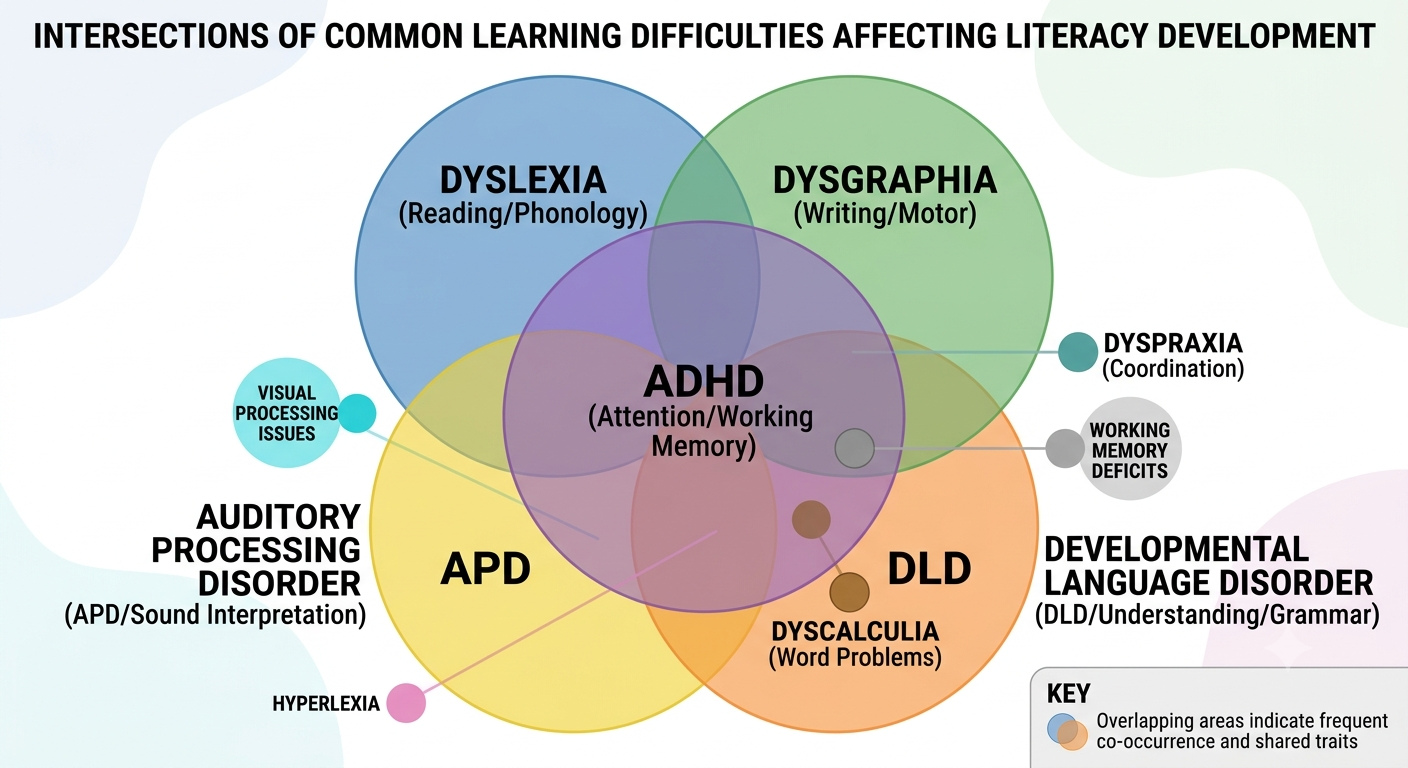
Learning Difficulties Affecting Your Child’s Literacy Development
But what happens when the words don’t seem to click? What if reading time turns into a daily battleground of tears, avoidance, and frustration?
If your child is falling behind their peers, it’s incredibly easy to worry. However, a struggle with reading or writing doesn’t mean your child isn’t intelligent. Often, hidden barriers known as learning difficulties or neurodivergent traits affect how a child’s brain processes written language.
Identifying these challenges early is the single most powerful step you can take. Below, we break down the 10 most common learning difficulties affecting a child’s literacy development, how to spot them, and exactly where to turn for support.
1. Dyslexia
Dyslexia is the most well-known learning difficulty impacting literacy. It is a neurological difference that specifically alters how the brain processes language. Children with dyslexia struggle with phonological awareness the ability to identify and manipulate the individual sounds (phonemes) that make up words.
What to look for:
- Difficulty matching letters to their corresponding sounds.
- Mixing up the order of letters in words when reading or writing (e.g., reading “left” as “felt”).
- Slow, hesitant reading and frequent guessing based solely on illustrations.
- Struggles with spelling even highly common, everyday words.
How to get help: If you suspect your child is showing signs of dyslexia, early screening provides the roadmap they need to thrive. You can reach out to the specialist team at the Indigo Dyslexia Centre for professional guidance, advanced screening, and tailored educational recommendations.
2. Dysgraphia
While dyslexia primarily targets reading, dysgraphia is a specific learning difficulty that directly impairs writing skills. It can manifest as a motor issue (the physical act of writing) or an information-processing issue (the ability to organize and express thoughts clearly on paper).
What to look for:
- An uncomfortably tight, painful, or awkward pencil grip.
- Highly inconsistent handwriting that alternates between print and cursive or uppercase and lowercase.
- Illegible spacing between letters or words.
- A massive gap between what your child can express verbally and what they can actually manage to write down.
How to get help: For support, physical exercises, and accommodation ideas regarding writing issues, consult national resources like the National Handwriting Association.
3. Developmental Language Disorder (DLD)
Developmental Language Disorder is a hidden but remarkably common condition that makes it difficult for children to understand and use spoken language. Because literacy is built entirely on a foundation of spoken language, a child who struggles to parse verbal sentences will almost always hit a wall when trying to read or write them.
What to look for:
- Difficulty finding the right words to express themselves or using very simplified grammar.
- Trouble following multi-step spoken instructions.
- Struggling to comprehend the narrative arc or deeper meaning of a story they just read.
- Misunderstanding idioms, metaphors, or abstract language.
How to get help: Speech and language therapists are key to managing DLD. Explore the support networks, resources, and advice hubs provided by Speech and Language UK.
4. Auditory Processing Disorder (APD)
Auditory Processing Disorder isn’t a form of hearing loss. Rather, it means that while the child’s ears hear sounds perfectly fine, their brain struggles to filter, interpret, and organize those sounds correctly. In a noisy classroom environment, a child with APD cannot easily distinguish the teacher’s voice from background chatter.
What to look for:
- Extreme difficulty learning phonics, because similar-sounding letters (like /b/ and /p/, or /t/ and /d/) blend together in their perception.
- Frequently asking people to repeat themselves (“What?” or “Huh?”).
- Becoming easily overwhelmed, distracted, or visually exhausted by loud or chaotic environments.
- Misinterpreting verbal jokes, directions, or stories.
How to get help: For information on diagnostic pathways and coping mechanisms for auditory sensitivity, check the resources at Brain.org’s APD Support Network or similar neurodiversity organizations.
5. ADHD (Attention-Deficit/Hyperactivity Disorder)
ADHD is primarily known as a behavioural or executive functioning challenge, but its ripple effects on literacy development are profound. Reading requires a complex cocktail of sustained focus, working memory, and impulse control.
What to look for:
- Skipping lines, missing words, or losing their place constantly while reading.
- Rushing through text so quickly that they miss essential details, leading to poor reading comprehension.
- Experiencing intense physical restlessness or frustration during quiet reading times.
- Forgetting what happened at the top of a page by the time they reach the bottom (due to working memory gaps).
How to get help: Tailored behavioural strategies can transform school life for an ADHD child. Look into the extensive guides and support systems available via ADHD UK.
6. Dyspraxia (Developmental Coordination Disorder – DCD)
Dyspraxia impacts fine and gross motor skills, coordination, and spatial awareness. When it comes to literacy, dyspraxia makes the physical layout of writing an exhausting, overwhelming task.
What to look for:
- Slow, laboured letter formation that exhausts the child quickly.
- Struggles with tracking text visually across a page without skipping words or lines.
- Difficulty organizing work on a page (e.g., margins are ignored, text slopes drastically downward).
- Frequent bumping into things, tripping, or general clumsiness.
How to get help: Occupational therapists play an essential role in building coordination skills. Find parental support networks and diagnostic info through the Dyspraxia Foundation.
7. Visual Processing Issues
Similar to how APD affects the brain’s interpretation of sound, Visual Processing Issues occur when a child’s eyes function normally, but their brain distorts the visual information it receives. This can also include Visual Stress, where the contrast of black text on a white page causes words to appear to vibrate, blur, or float.
What to look for:
- Complaining of headaches, eye strain, or physical fatigue after reading for only a few minutes.
- Reversing entire words (e.g., reading “saw” as “was”) or letters well past the age where it is developmentally typical.
- Struggling to copy notes accurately from a school whiteboard down onto a piece of paper.
- Using a finger or a ruler to hold their place on every single sentence.
How to get help: Behavioural optometrists can test for these processing differences. Organizations like SeeAbility offer fantastic guidance on children’s vision and learning needs.
8. Hyperlexia
Hyperlexia is an intense, precocious ability to decode words and read text at an incredibly young age often far ahead of their expected developmental milestones. However, there is a catch: while a child with hyperlexia can read complex words perfectly aloud, they often have a very low level of comprehension regarding what those words actually mean.
What to look for:
- An obsessive, intense fascination with letters, numbers, and books as a toddler.
- An ability to read words fluently without ever being formally taught.
- Significant difficulty answering basic questions about a story they just read perfectly.
- Spoken language delays or difficulties with social communication (hyperlexia is frequently associated with the autism spectrum).
How to get help: For holistic support balancing reading skills with social communication, explore the insights and toolkits at the National Autistic Society.
9. Working Memory Deficits
Working memory is the mental “sticky note” your brain uses to temporarily hold onto information while you complete a task. In literacy development, a child uses working memory to hold onto the beginning sounds of a word while they decode the rest of it, or to hold onto the context of a sentence while figuring out the meaning of a paragraph.
What to look for:
- Sounding out a word perfectly on one line, but failing to recognize the exact same word three lines later.
- Forgetting the instructions of a writing assignment halfway through the first sentence.
- Struggling to blend sounds together into words because the initial sounds are forgotten before the final sounds are reached.
How to get help: Memory scaffolding techniques can be highly effective. The educational resource foundation Mencap offers superb advice on supporting children with core cognitive and memory retention struggles.
10. Dyscalculia (Affecting Written Word Word-Problems)
While dyscalculia is widely recognized as a math learning difficulty (similar to dyslexia but for numbers), it severely hinders specific areas of literacy development namely, reading comprehension involving math vocabulary and interpreting structured data.
What to look for:
- Extreme confusion or stress when a reading passage introduces numbers, dates, charts, or temporal words (e.g., before, after, decade).
- An inability to process and solve written “word problems” in school, even if their basic reading mechanics are strong.
- Difficulties tracking chronological structures or sequence-heavy plots in books.
How to get help: Comprehensive support for mathematical literacy barriers can be found at the Dyscalculia Network and for professional screening, and tailored educational recommendations you can come to the indigo dyslexia centre .
What Should You Do Next?
If you recognized your child in several of these points, take a deep breath. Knowing what you are up against is a major victory. The human brain is incredibly adaptable, and with the right intervention, accommodations, and encouragement, children with learning difficulties go on to become highly successful readers, writers, and thinkers.
Your Action Plan:
Seek Specialist Guidance: Don’t rely on guesswork. Professional screening helps strip away the mystery and provides you with a clear, step-by-step roadmap to give your child their confidence back.
Keep a Log: Spend a week jotting down specific moments where your child struggles. Note exactly what they do, when they become frustrated, and what strategies seem to help.
Speak with the School: Schedule a meeting with your child’s teacher or the school’s Special Educational Needs Coordinator (SENCo). Share your observations and ask if they notice similar patterns in class.