

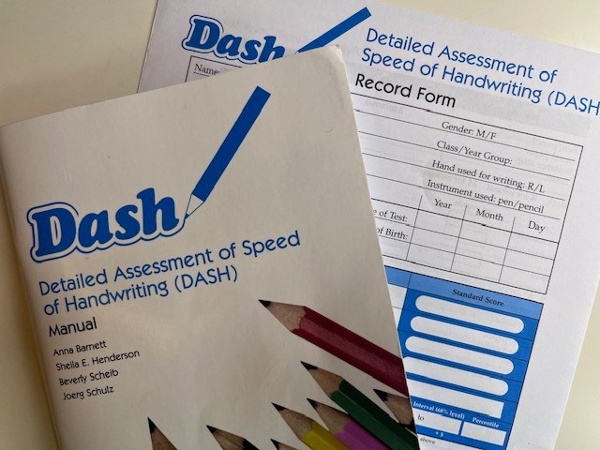
The Detailed Assessment of the Speed of Handwriting – 2nd Edition (DASH-2)
Released following standardisation efforts conducted between August 2021 and February 2023, DASH-2 supersedes the original DASH (2007) and DASH 17+ (2010) editions. Designed to measure the speed and legibility of handwriting across various tasks with differing cognitive and motor demands, this revised battery is now applicable for an extended age range of 8 to 25 years. Importantly, it is designated for use by “All professionals including class teachers,” suggesting a broad utility in both educational and clinical settings for identifying difficulties in written output.
Battery Structure and Administration
DASH-2 is structured around five key tasks, designed to isolate different components of the handwriting process. The total administration time for the entire battery is approximately 30 minutes.
The core of the assessment comprises four tasks:
- Sentence Copying (Best): Measures the speed of writing legibly.
- Sentence Copying (Fast): Assesses the maximum attainable writing speed.
- Alphabet Writing: Gauges the automatisation and speed of letter production.
- Free Writing: Measures handwriting speed and fluency when language formulation is required.
These four tasks form the basis for the overall Total Composite Score. A fifth, supplementary task, Graphic Speed, measures the speed of controlling a writing implement under high perceptual-motor demands but without any language element. The inclusion of this supplementary task allows for a clearer differentiation between challenges rooted in fine motor control and those related to the integration of motor and language planning.
Administration is straightforward, requiring a timer, paper, and pens, and yields all evidence from the timed writing of the student or young person. A noteworthy aspect of the administration is the flexibility in task selection to ensure fairness and rigour. Specifically, there is a choice of two copying sentences for two distinct age groups (8-16 and 17-25 years). For the Free Writing task, two topics are available: one which is the same as the previous edition (‘My Life’) and an alternative, more cognitively challenging topic (‘Past, present, future’). The alternative topic is recommended when the examiner wants to assess handwriting speed with greater cognitive load, or when repeating the assessment. The manual advises that all five tasks should be administered, as the sum of the four core task scaled scores provides the most reliable overall measure of legible handwriting speed, with Graphic Speed adding crucial fine motor information.
Robust Standardisation and Reliability
The psychometric foundation of DASH-2 is built on a rigorous standardisation study involving 762 participants from the UK, Australia, and New Zealand—regions considered demographically and educationally similar. The total sample included 533 participants in the younger (8-16 years) age group and 229 in the older (17-25 years) group, with nearly equal gender representation (377 males, 385 females). This sample was found to be representative of the census information for both the UK and the combined Australia/New Zealand populations across age, gender, ethnicity, and socio-economic backgrounds. Importantly, the 17-25 age norm groups were combined for those in and not in educational settings, as no significant difference in scores was found between these sub-groups.
The reliability of DASH-2 is considered acceptable or better across all key measures. Test-retest reliability for the four core tasks ranged from .71 to .86, reaching .89 for the Total Standard Score over a 2–13 week period. Inter-rater reliability was also found to be adequate across all ages. The document highlights the critical importance of using the 95% confidence interval for the Total Standard Score—a mandatory requirement reaffirmed by SASC guidance—which generally ranges around 16–18 points around the actual standard score. The stability coefficients for the supplementary Graphic Speed task were noted as the lowest (.68 and .74 for younger and older ages, respectively), though still falling within the acceptable range of reliability coefficients (.60–.70).
Scoring, Interpretation, and Validity
Scoring yields a scaled score for each task, with a mean of 10 and a standard deviation (SD) of 3. The primary output is the Total Composite Score, a standard score derived from the sum of the four core tasks, featuring a mean of 100 and an SD of 15. The factor analysis confirmed that this Total Composite Score serves as a valid global indicator of handwriting speed.
The construct validity of DASH-2 is strong. An expert panel confirmed the content aligns with the constructs of handwriting speed and accuracy. The low correlations between the Graphic Speed task and the Total Standard Score (.39), and with the individual core tasks (.29–.36), support its designated supplementary role, confirming that it measures a distinct, isolated perceptual-motor skill separate from the integrated skills required for the core tasks (which correlated strongly, from .79 to .91).
A key diagnostic insight is derived from comparing the Copy Best and Copy Fast speeds. A ‘Copy Speed Difference’ score that lies at or below the 15th percentile suggests a lower than average ability to increase writing speed, potentially indicating a difficulty in adjusting speed. This threshold is defined differently across age groups (e.g., 1 word or less for 8–11 years, 4 words or less for 17–25 years).
Clinical and Contextual Insights
Beyond the quantitative scores, DASH-2 places significant emphasis on a qualitative assessment, providing useful guidance on observable factors. This includes a review of handwriting mechanics (the ‘7Ss’), pen grip, posture, pen pressure, signs of pain or fatigue, and fluency of writing. For the Free Writing task, the qualitative assessment extends to fluency in formulating sentences and the inclusion of language mechanics such as punctuation, spelling, and grammar.
The manual also offers crucial contextual advice. A small-sample study examining group versus individual administration for 11–15 year olds found mean scores were slightly higher when tested individually, with statistically significant differences noted for the Copy Fast and Total Standard Scores. Therefore, examiners are advised to consider the assessment setting during interpretation. Furthermore, test developers caution against directly comparing DASH-2 norms with those of the previous editions, DASH (2007) and DASH 17+ (2010). They attribute the observed slower handwriting speeds in the new norms to two factors: the 14–17 year societal shift towards increased technology use and a consequent decrease in handwriting practice, and revisions made to the task administration and scoring guidelines themselves.
DASH-2 and Specific Learning Difficulties (SpLDs)
DASH-2 provides data on specialist groups, highlighting its utility in differential diagnosis. The Dyslexic group (40 participants) demonstrated lower mean scores across all tasks except for Graphic Speed, suggesting their primary challenge may not be in isolated fine motor control. Conversely, the Developmental Coordination Disorder (DCD) group (33 participants) showed lower mean scores on all tasks, including Graphic Speed, indicating broader motor involvement. While the test can assist in the diagnostic process for Specific Learning Disorder with Impairment in Written Expression (often referred to as dysgraphia), the manual is clear: DASH-2 is not designed to diagnose dysgraphia, as there is no current professional consensus on specific diagnostic criteria for the disorder, which the DSM-5 includes under the broader Specific Learning Disorder category.
In conclusion, DASH-2 stands as a thoroughly updated and well-validated assessment tool. With its rigorous standardisation, demonstrated reliability, and integrated approach to measuring both speed and legibility alongside qualitative factors, it offers clinicians and educators a comprehensive method for evaluating a pupil or young person’s functional handwriting skills across a broad age span. The emphasis on using the 95% confidence interval and the specific guidance on comparing Copy Best and Copy Fast speeds provides enhanced clinical utility for identifying handwriting difficulties.