

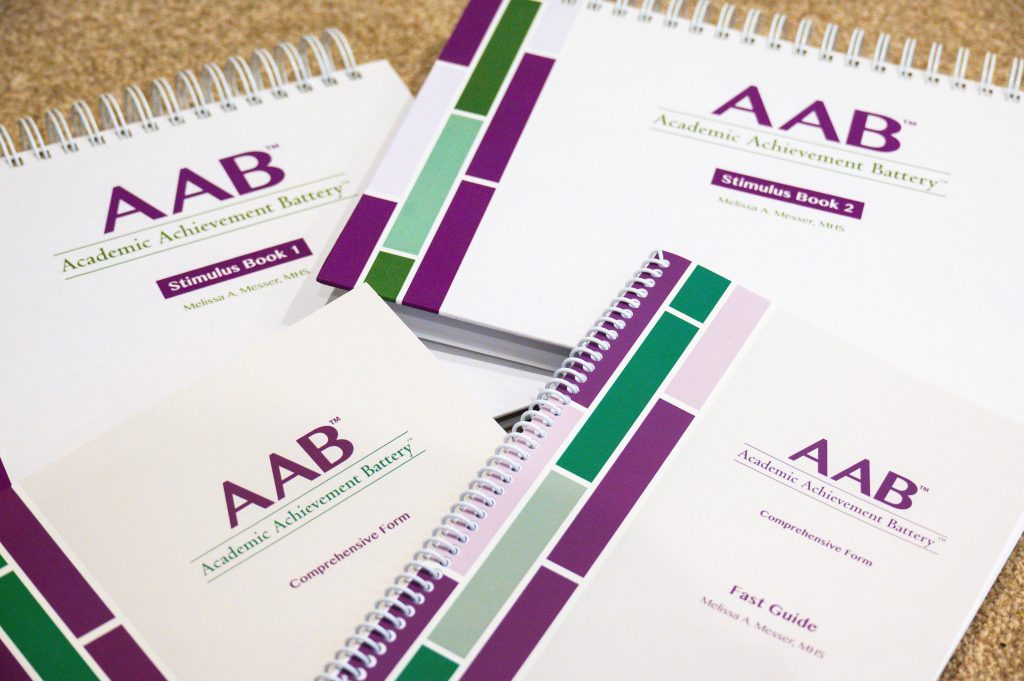
A Comprehensive Guide to the Academic Achievement Battery (AAB)
One instrument that has gained traction in recent years is the Academic Achievement Battery (AAB). Developed by Melissa A. Messer and published by PAR in 2014, the AAB offers a broad look at academic performance across the lifespan (ages 4–85). But is it the right choice for a UK-based dyslexia diagnostic assessment?
In this guide, we’ll dive deep into the AAB’s structure, its advantages in the context of dyslexia, and the significant cultural hurdles UK assessors must navigate.
What is the Academic Achievement Battery (AAB)?
The AAB is a comprehensive achievement test designed to evaluate the fundamental skills affected by neurodivergence. For dyslexia specifically, it targets the “Big Three” of literacy: reading, spelling, and writing.
The battery is structured into 15 sub-tests that feed into seven composite scores. These eventually culminate in a total Academic Achievement Battery Composite. Because it is standardized up to age 85, it is a versatile tool for those working with children, adolescents, and adults in workplace or Higher Education (HE) settings.
The AAB Structure: A Breakdown for Dyslexia Specialists
To understand how the AAB fits into a dyslexia profile, we must look at the specific domains it assesses. Dyslexia is characterized by difficulties with accurate and/or fluent word recognition and poor spelling and decoding abilities. Here is how the AAB maps to those areas:
1. The Reading Domain
The AAB splits reading into several granular components:
- Basic Reading: Includes Reading Foundation Skills (for younger learners) and Letter/Word Reading.
- Reading Fluency: A critical area for dyslexia diagnosis. Many dyslexic individuals can decode accurately but lack the automaticity required for fluency.
- Reading Comprehension: Evaluated through “Words and Sentences” and “Passages.”
2. The Written Expression Domain
Writing is often the “forgotten” struggle in dyslexia. The AAB covers:
- Spelling: Both Letter Writing and Word Writing.
- Written Composition: Assessing the ability to construct meaningful text.
- Pre-Writing Skills: For early years assessment.
3. Oral Language and Mathematics
While not “core” dyslexia markers, Listening Comprehension, Expressive Communication, and Mathematics (Calculation and Reasoning) are vital for identifying co-occurring difficulties or determining if a literacy deficit is specific or part of a broader learning profile.
Advantages of Using the AAB in Dyslexia Assessments
Why might a specialist choose the AAB over more traditional mainstays like the WRAT or the WIAT?
Updated Standardization
One of the most compelling reasons to use the AAB is its recency. The word reading and spelling sub-tests feature more updated standardization than older versions of the WRAT or WIAT-II UK. In an era where educational norms shift rapidly, having a contemporary normative sample is a significant clinical advantage.
Accessible Reading Fluency
Reading fluency is often a “missing link” in basic screening. The AAB’s fluency sub-test is widely considered accessible and highly useful for identifying those “stealth dyslexics” who can decode but struggle with the speed of processing text. Even though the adult topics occasionally lean toward US culture, the underlying metric of reading speed remains a powerful diagnostic indicator.
Clinical Group Data
The AAB manual provides valuable data comparing the performance of typical learners against four clinical sub-groups, including those with a Specific Learning Disability (SpLD). This allow assessors to see how an examinee’s profile “fits” against established dyslexia patterns.
Flexibility for Specialist Assessors
The AAB is open to specialist teacher assessors (Level 7), making it a flexible addition to the private practitioner’s toolkit. Furthermore, it can be purchased as a full battery or as a shortened screening version (roughly £153–£155), which focuses on the “essentials”: word reading, spelling, written composition, and math.
The “Americanism” Hurdle: Critical Pitfalls for UK Assessors
While the AAB is technically robust, UK assessors must tread carefully. Because the test originated in the US, there are several “cultural glitches” that could potentially invalidate your results if not handled with professional skepticism.
1. Language and Speech Conventions
The sub-tests for Oral Expression contain specific US speech conventions. For example, a prompt might ask an examinee to “Tell them how to fix this sentence.” For a UK student used to different grammatical terminology or phrasing, this can lead to confusion that has nothing to do with their actual linguistic ability.
2. The Mathematics Problem
For UK assessors, the Mathematical Calculation sub-test is perhaps the most problematic. It includes:
- Symbols and Tasks: Methods like the manual calculation of logarithms are rarely part of the standard UK curriculum in the same way.
- Units of Measurement: The test requires familiarity with both Imperial and Metric weights and measures. While older UK adults may be comfortable with this, younger students may struggle with the Imperial components.
3. Reading Comprehension Validity
A significant concern for dyslexia specialists is the Reading Comprehension Passages sub-test. In this section, examinees are asked to insert punctuation. A student with a strong grasp of sentence structure but poor overall comprehension could theoretically score well here without actually understanding the meaning of the passage. This could lead an assessor to overestimate a dyslexic student’s functional reading level.
Administration Realities: Time and Setting
If you are planning to integrate the full AAB into your diagnostic battery, you need to manage your clock.
- Duration: Expect a minimum of 90 minutes for the full battery.
- Untimed Sections: Because several sub-tests are untimed, a student with significant dyslexia—who may have slow processing speed or high levels of anxiety—could take considerably longer.
- Higher Education (HE) Caution: If you are assessing for Disabled Students’ Allowances (DSA), be wary. Certain sub-tests like Oral Production and Oral Expression are often deemed inappropriate or unnecessary for HE settings.
Is the AAB Right for Your Practice?
The Academic Achievement Battery is a sophisticated, modern tool that offers a fresh perspective on literacy and numeracy. For the dyslexia assessor, its updated spelling and reading fluency norms are a major “pro.”
However, the “con” is the mental gymnastics required to filter out US-specific content. To use the AAB effectively in the UK, you must:
- Be selective: Consider using the shortened screening version or specific sub-tests rather than the full battery.
- Qualitative Analysis: If a student fails a math or oral expression item, ask yourself: Is this a learning difficulty, or is this a cultural barrier?
- Contextualize: Always report the scores within the context of the examinee’s background and the UK curriculum.
Summary Table for Assessors
| Feature | Benefit for Dyslexia Assessment | Drawback for UK Use |
| Word Reading | Recent standardization; robust norms. | Occasional American spelling variations. |
| Reading Fluency | Excellent for identifying processing speed issues. | Adult topics are US-centric. |
| Written Composition | Comprehensive look at writing. | No specific measure of writing speed (WPM). |
| Math Calculation | Covers a broad range of skills. | Includes non-curriculum tasks (Logarithms). |
Final Thoughts
The AAB is a powerful instrument, but it is not a “plug-and-play” solution for the UK market. It requires a high level of clinical judgment. If you value updated norms and a strong focus on reading fluency, the AAB is well worth the investment—provided you keep your “cultural filter” turned on.
Thinking of purchasing? The full kit is available from UK distributors like Ann Arbor (£427.00) or Hogrefe (£422). For those on a budget, starting with the manual and specific stimulus books can be a way to phase the tool into your practice.
Professional Tip: When using the AAB for a dyslexia diagnosis, always supplement the Written Expression scores with a separate measure of writing speed, as the AAB lacks a dedicated “words per minute” metric.
This guidance is intended for qualified specialist assessors and educational psychologists. Always refer to the publisher’s manual for specific administration and scoring instructions.