

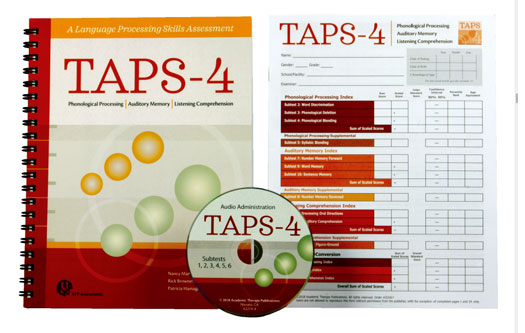
TAPS-4: A Language Processing Skills Assessment
TAPS-4
The STEC review of the TAPS-4 (Test of Auditory Perceptual Skills, 4th Edition) highlights a pivotal rebranding and repositioning of the instrument, moving away from the narrow construct of “Auditory Processing” to the broader, more theoretically grounded domain of “Oral Language Processing.”
The rationale for this shift is rooted in contemporary neurological and developmental theory. As the manual explains, the term “auditory processing” is now generally conceptualized as a narrow set of skills related to the Central Nervous System’s processing of the acoustic signal. Oral language processing, however, is a far wider construct, encompassing phonological awareness, auditory attention, auditory memory, and conceptual knowledge. Given that Language Processing Deficits are common across a spectrum of developmental and learning conditions, the TAPS-4 is positioned as a critical measure for identifying underlying factors contributing to reading, writing, and general communication challenges. It is developed in line with current theories of language processing and the Cattell–Horn–Carroll (CHC) theory, with its index structure supported by factor analysis. The test is applicable across a wide age range, from 5 years, 0 months (5:0) up to 21 years, 11 months (21:11).
Structure and Scope: Three Pillars of Language Processing
The TAPS-4 is designed for flexible use, allowing assessors to administer single subtests, one or two indices, or the entire battery. It features updated and expanded norms, including individuals with conditions like Specific Language Impairment, Hearing Impairment, ADHD, and Learning Disabilities. The test is organized around three core indices, each probing a distinct yet interrelated aspect of language processing.
1. Phonological Processing Index
This index is crucial for assessing the foundational skills of sound manipulation and identification, which are highly predictive of literacy outcomes. To ensure consistent pacing and pronunciation, all subtests in this index must be administered via an accompanying audio CD. Core subtests include:
- Word Discrimination: Identifying whether a heard word pair is the same or different.
- Phonological Deletion: Saying a word without an identified syllable or phoneme.
- Phonological Blending: Combining a series of phonemes into a complete word.
The STEC review specifically praises the inclusion of a supplemental subtest, Syllabic Blending, which uses nonwords. This is deemed particularly useful for older students, as it provides a purer measure of phonological skills, circumventing the ability to easily recognise or guess real words.
2. Auditory Memory Index
The Auditory Memory Index moves beyond simple rote recall by employing a range of measures, providing greater confidence when weaknesses are found and allowing for the comparison of results at different levels of meaning. These subtests are presented verbally by the examiner:
- Number Memory Forward: Repeating a series of single-digit numbers in the same order (primarily short-term memory).
- Word Memory: Repeating a series of words in the same order (primarily short-term memory).
- Sentence Memory: Repeating a sentence exactly as said, which relies not only on memory but also on syntactical knowledge.
A supplemental subtest, Number Memory Reversed, is also included, offering a focused measure of working memory by requiring the examinee to repeat numbers in the correct reversed order.
3. Listening Comprehension Index
This index assesses the ability to process and understand spoken language. It is administered through a mix of examiner-presented and CD-administered subtests. Core components include:
- Processing Oral Directions: Responding to a short scenario and direction (CD required).
- Auditory Comprehension: Answering questions (including inferential and figurative language items) after hearing a short passage.
A highly valuable supplemental subtest is Auditory Figure-Ground. This involves scenarios similar to Processing Oral Directions, but presented against competing background noise. The use of complementary items with similar structure allows assessors to determine if an individual struggles specifically with comprehension in noisy environments.
Distinct Advantages for Specialist Assessors
The TAPS-4 receives high marks for several practical and psychometric advantages. Crucially, the test is classified as ‘Open’ to Specialist Assessors, provided they have formal training in psychometrics, understand derived scores, and appreciate the limitations of test results.
The assessment’s flexibility—in terms of subtest choice and administration order—is a major strength. The manual is described as clear and easy-to-follow, offering useful information on factors that may influence performance in each subtest and actively encouraging qualitative evaluation. This qualitative focus, along with the purposeful omission of descriptive ranges, ensures that interpretation is contextual and based on the assessment’s purpose rather than rigid bands.
Psychometrically, the TAPS-4 demonstrates good reliability for its three indexes and the overall score, and validity checks indicate it effectively differentiates between subgroups, such as those with specific learning difficulties. The move to standard audio administration for certain subtests, while presenting some challenges (discussed below), is also noted as an advantage for improving consistency across different examiners.
Critical Cautions and Considerations
Despite its strengths, the STEC review raises several important cautions, primarily related to standardization and administration.
The most significant concern is the US-centric nature of the assessment. While the norms are up-to-date, they are US-based and may not fully reflect the demographics of other countries. Furthermore, the CD administration uses an American accent, and the content includes American references (e.g., ‘basketball’ and ‘cookies’). The use of a different accent and specific cultural terminology may slightly interfere with a non-US examinee’s short-term memory or processing, potentially lowering scores. Although the test developer suggests making allowances for different dialects and noting any affected items, this remains a significant factor for assessors to manage.
For older students, the core phonological processing subtests (Word Discrimination, Phonological Deletion, Blending) require particular caution. As phonological skills typically hit mastery relatively early, these tests can suffer from ceiling effects for individuals aged 10 and above. For this older group, scores do not follow a normal distribution, and a score of 85 or above may not accurately reflect an absence of difficulty, especially since just one or two errors can lead to a significant score drop. Assessors must interpret these scores within the context of other evidence of literacy weaknesses.
Administration issues are also noted. The rate of delivery on the CD, particularly for phonological processing subtests, is perceived as slow, potentially increasing the demands on working memory and attention for older students. The instructions on the CD are also described as slow and potentially frustrating for adult examinees. Assessors are strongly advised to practice thoroughly with the CD administration, including the necessary pausing between items, to ensure a smooth and standardized experience.
Finally, caution is needed when interpreting the Auditory Comprehension subtest for higher-level students. For this group, the language in the listening passages may not be sufficiently complex; consequently, a high score may primarily reflect an ability to accurately recall what was heard rather than a deep or complex understanding of the content. While this makes it a useful measure for exploring issues with remembering verbal information, it should be used with prudence when analysing underlying comprehension skill.
Conclusion
The TAPS-4 (Test of Auditory Perceptual Skills, 4th Edition) can be a critical component of a comprehensive dyslexic assessment because it evaluates the cognitive infrastructure required for effective reading and spelling. While dyslexia is primarily recognized as a difficulty with word recognition and decoding, these challenges are often rooted in deficits within the auditory-phonological system.
The TAPS-4 specifically measures how an individual perceives, remembers, and manipulates oral language—skills that directly underpin the ability to map sounds to letters. By assessing sub-levels such as phonological processing, auditory memory, and auditory cohesion, the TAPS-4 provides a nuanced profile of an individual’s ability to retain and sequence verbal information. This allows clinicians to differentiate between a simple lack of exposure to text and a fundamental neurological difference in how auditory information is integrated, thereby facilitating more targeted and effective remedial strategies.