

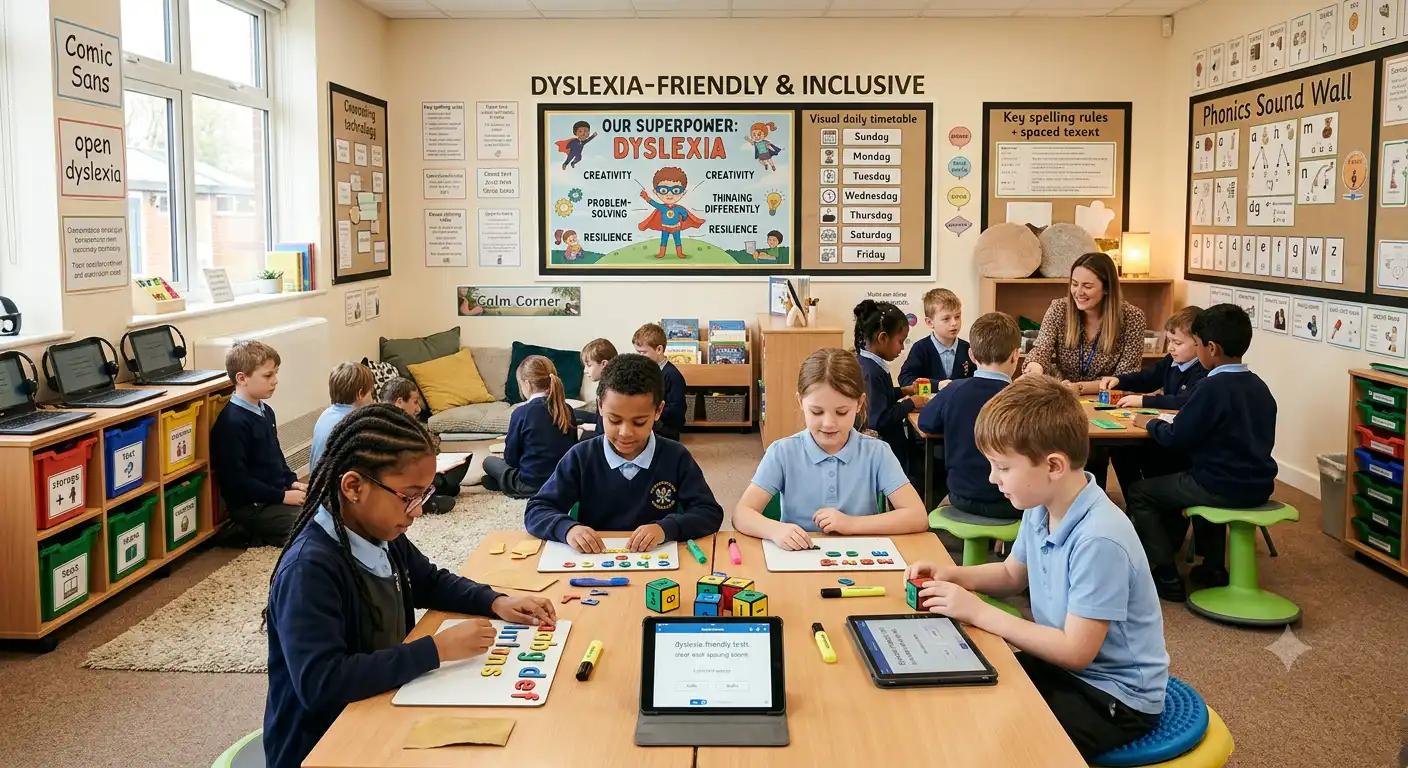
Inclusive Classroom for Dyslexia?
For a long time, the traditional educational approach focused on what was “wrong” with the student, treating dyslexia as a deficit that required external remediation. However, modern educational frameworks are shifting toward the social model of disability. This model argues that barriers exist within the environment, not the individual.
When schools focus on creating a dyslexia-friendly environment, the need for intensive, separate interventions decreases. Instead, the focus shifts to designing learning environments that accommodate and support everyone right from the start.
So, what exactly makes a classroom inclusive for dyslexia? It goes far beyond simply providing coloured overlays or extra time on exams. True inclusion requires a thoughtful combination of layout, teaching methods, adaptive technology, and emotional support.
1. High-Impact Dyslexia-Friendly Layouts and Materials
An inclusive environment begins with how information is visually presented. Students with dyslexia often experience visual stress, tracking difficulties, or working memory overload when faced with dense blocks of text.
Typography and Formatting
The layout of your handouts, worksheets, and presentations can completely change a student’s ability to engage with content.
- Font Choice: Avoid serif fonts (like Times New Roman), which have decorative feet that make letters blend together. Instead, use clean, sans-serif options such as Arial, Verdana, Calibri, or Comic Sans.
- Spacing: Use a minimum of 1.5 line spacing and larger letter-spacing to prevent lines of text from blurring together.
- Background Contrast: Pure white backgrounds on digital whiteboards or printed paper can cause a glaring effect. Soft, pastel backgrounds (such as cream, light blue, or yellow) drastically reduce visual strain.
Structuring Content for Scanability
Dyslexic learners are often “big picture” thinkers. They process concepts beautifully when they understand the macro-level context before diving into the details.
- Bite-Sized Chunks: Avoid long, dense paragraphs. Break text up with descriptive headings and short bullet points.
- The “Big Picture” Overview: Always provide a clear visual map or summary of the lesson’s goals at the very beginning, and recap them at the end.
2. Evidence-Based Teaching Approaches
Inclusive classrooms do not just change what students look at; they change how students learn. Traditional classrooms rely heavily on a “read, write, listen” loop. An inclusive classroom uses multi-sensory and structured learning strategies.
Multi-Sensory Instruction
Multi-sensory teaching engages more than one sense at a time. When a student uses sight, sound, movement, and touch simultaneously, it provides their brain with multiple pathways to anchor and retain memory.
| Sensory Channel | Inclusive Classroom Example |
| Visual | Using color-coded grammar blocks, storyboards, timelines, and mind maps. |
| Auditory | Incorporating rhymes, phoneme-blending songs, and audiobooks. |
| Kinaesthetic/Tactile | Tracing letters in sand, building words with magnetic letters, or using physical counters for maths. |
Over-Learning and Cumulative Structure
Working memory can hold a limited amount of information at once. Because dyslexic students expend significantly more cognitive energy decoding individual words, their working memory can quickly become overloaded.
To combat this, teach one concept at a time in a highly structured, cumulative sequence. Do not move on to step B until step A is thoroughly mastered. Build in frequent opportunities for “over-learning” which means practicing a skill past the point of initial mastery until it becomes automatic.
3. Assistive Technology as a Standard Tool
In an inclusive classroom, assistive technology is not an “extra” hidden away in a special educational needs (SEN) room. It is integrated seamlessly into everyday learning, accessible to any student who needs it.
- Text-to-Speech (TTS): Software that reads digital text aloud allows students to access high-level curriculum content without being held back by their mechanical reading speed.
- Speech-to-Text (Dictation): Many brilliant students appear bright and articulate verbally but struggle to get their thoughts down on paper. Dictation tools remove the mechanical bottleneck of spelling and handwriting, letting their actual knowledge shine.
- Audio Recording: Taking notes while listening to a teacher is an incredibly complex cognitive task. Allowing students to use digital voice recorders lets them focus entirely on understanding the lecture, knowing they can review the audio later.
4. Prioritising Emotional Intelligence and Self-Esteem
The emotional impact of navigating an unsupportive school environment can be deeply damaging. Many children with dyslexia internalise their struggles, viewing themselves as “slow” or “not smart,” which can quickly lead to school anxiety or disruptive behaviour meant to mask their academic frustrations.
An inclusive classroom deliberately fosters an open, neurodiverse culture where mistakes are treated as normal parts of the learning process.
“If they don’t learn the way we teach them, we must teach them the way they learn.”
Teachers should actively highlight and celebrate the distinct cognitive strengths often associated with dyslexia, such as advanced problem-solving, vivid imagination, spatial design, narrative skills, and lateral thinking.
Could It Be Dyslexia? The Critical First Step
It is common for parents, teachers, or even adults looking back on their own education to recognize these patterns and wonder if dyslexia is the root cause of their struggles.
If you or someone you care about exhibits a persistent gap between their obvious intelligence and their day-to-day reading, writing, or spelling performance, the absolute first step is to undergo a formal dyslexia screening test.
Why a Screening Test Matters
A screening test is a preliminary, accessible assessment designed to identify whether an individual shows the classic markers and behavioural indicators of dyslexia.
- Early Identification: It highlights specific areas of vulnerability such as phonological processing, working memory, or rapid automatic naming long before a child falls significantly behind their peers.
- Targeted Support: Rather than guessing which interventions might work, a screening profile gives educators, specialists, and parents a clear roadmap of exactly where support is needed.
- Peace of Mind: For many individuals, a screening test provides an immediate sense of validation, transforming a vague sense of personal frustration into an objective, manageable learning difference.
While a screening test is not a full diagnostic assessment, it is the essential catalyst that opens the door to effective adjustments, classroom accommodations, and tailored learning strategies.
Summary: Designing for All
Ultimately, creating an inclusive classroom for dyslexia does not mean rewriting the entire curriculum, nor does it disadvantage non-dyslexic peers. In fact, evidence consistently shows that clean layouts, multi-sensory teaching, clear structures, and accessible technology benefit every single student in the room. By building an environment that embraces different ways of thinking, we create a space where every learner has the opportunity to thrive.