

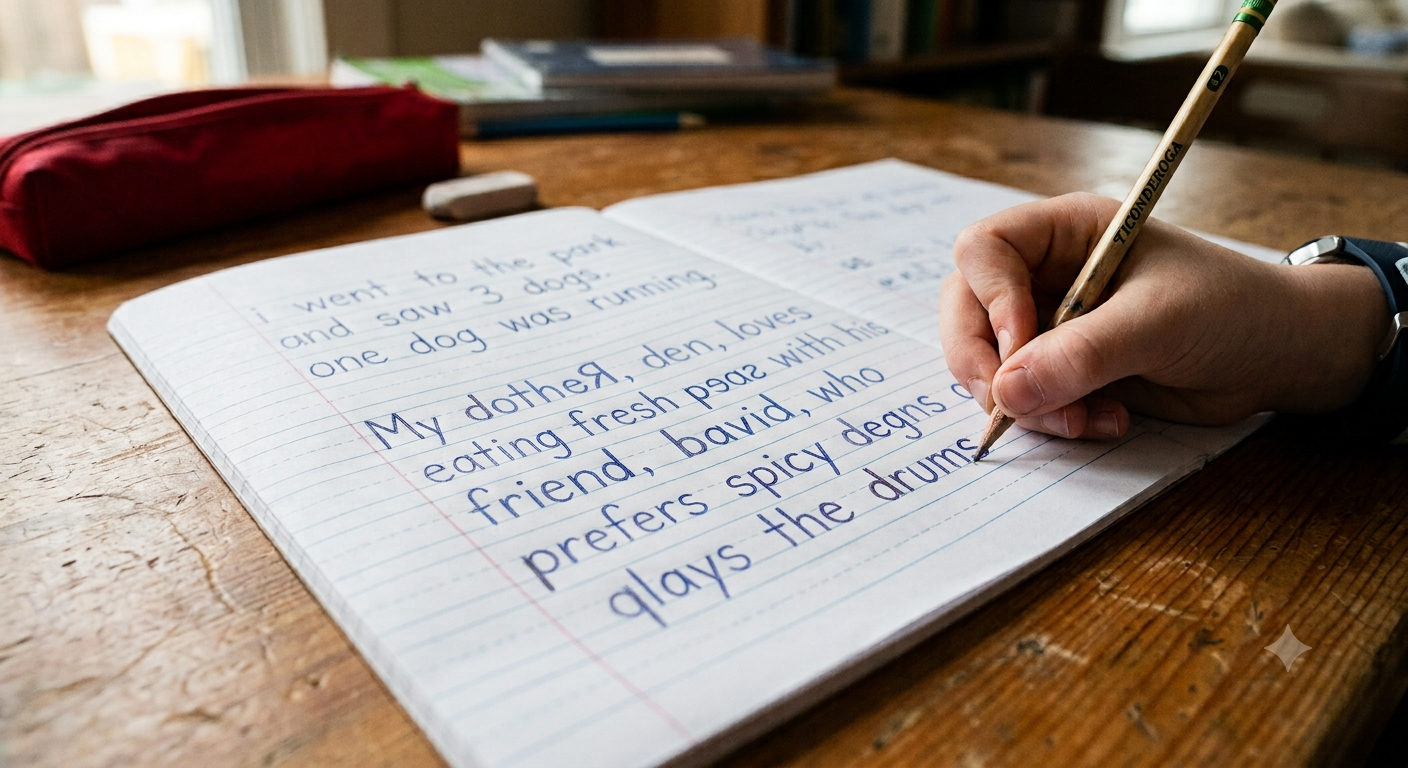
Writing Letters Backwards
The immediate question that springs to mind for many parents is: Is this a sign of dyslexia?
It is a incredibly common worry, but the short answer is usually reassuring: in early childhood, writing letters backwards is a completely normal, healthy milestone of literacy development.
However, there does come a point where letter reversals transition from a typical learning quirk into a potential indicator of a learning difference. To help you understand your child’s progress, this guide breaks down the science behind mirror writing, maps out the developmental timeline, identifies the genuine “red flags” of dyslexia, and provides practical ways to support your young writer.
Why Do Young Children Write Backwards?
To understand why children reverse letters, we have to look at how the human brain processes the world around it.
From infancy, our brains use a concept called object invariance. This means that an object is the exact same thing regardless of its orientation. A coffee mug is still a coffee mug whether the handle faces left, faces right, or is turned completely upside down. Your brain automatically strips away the directionality because, in nature, direction doesn’t alter an object’s core identity.
When children learn to read and write, they have to completely retrain their visual processing systems to override this hardwired setting. For the first time in their lives, directionality matters.
- A vertical line with a loop on the bottom right is a b.
- Flip that loop to the left, and it becomes a d.
- Flip it upside down, and it becomes a p or a q.
For a five- or six-year-old, mastering this exception to the rule takes time, physical practice, and neurological maturation. It isn’t that they are seeing the world incorrectly; rather, their brains are simply treating letters with the same flexible logic they apply to everything else in their environment.
The Timeline: When Is It Normal and When Is It a Red Flag?
Because literacy develops at different speeds for every child, there isn’t a single “cutoff day” where reversals instantly become problematic. Instead, educators and specialists look at ages and school stages to determine when to investigate further.
Ages 4 to 7— Typical Development
During these early school years, letter and number reversals are remarkably common. Children are building up their fine motor skills, learning phonics (matching sounds to letters), and discovering spatial awareness on a page.
- What you see: Frequent mix-ups with b/d, p/q, s/z, and numbers like 3, 5, and 7. You might also notice “mirror writing,” where a child starts writing from the right side of the page and moves left.
- The Verdict: This is entirely normal. At this stage, reversals are a sign that a child is actively experimenting with shape formation. It is not an accurate indicator of dyslexia.
Age 7 to 8— The Transition Zone
By the time children reach age 7 or 8, they have had a few years of formal literacy instruction. Their visual word processing network is becoming more specialized, and the brain has generally learned to prioritize left-to-right directionality.
- What you see: Letter reversals should begin to drop off sharply. While an occasional slip-up might happen when a child is tired or writing quickly, it should no longer be their default way of writing.
- The Verdict: If a child is still frequently and consistently reversing letters by the end of Year 2 or the start of Year 3, it warrants closer attention.
Age 8 and Beyond — The Potential Red Flag
If a child is over the age of 8 and continues to flip letters, write backwards, or struggle to see that their letters are oriented incorrectly, it is no longer considered a standard developmental phase.
- The Verdict: Persistent reversals at this age can point toward an underlying challenge. This could be related to visual processing skills, working memory weaknesses, or a specific learning difficulty like dyslexia.
Dyslexia is More Than Just “Backwards Letters”
One of the most enduring myths about dyslexia is that it is a visual problem where letters float around or flip upside down on the page. In reality, dyslexia is a language-based learning difference rooted in how the brain processes speech sounds.
The core challenge for a child with dyslexia is usually phonological awareness the ability to break down spoken words into their individual distinct sounds (phonemes) and map those sounds onto written letters.
Because a child with dyslexia struggles to anchor the sound of a letter to its visual shape, remembering the exact orientation of that shape becomes incredibly difficult. The letter reversal isn’t the cause of their reading trouble; it’s a byproduct of a memory and language-processing bottleneck.
True Red Flags of Dyslexia to Watch For
If your child is past the age of 7 and you are wondering if their writing reversals are a symptom of dyslexia, look for a cluster of these accompanying signs:
| Area of Difficulty | Specific Behaviours & Signs |
| Reading & Decoding | * Reading slowly, hesitantly, or with significant effort. * Sounding out a word (like c-a-t) but being unable to blend it into “cat.” * Guessing wildly at unfamiliar words based solely on the first letter. |
| Spelling & Writing | * Leaving vowels out of words entirely (e.g., writing “bgt” for “big”). * Transposing the internal order of letters within words (e.g., writing “dose” instead of “does”). * Extreme difficulty spelling common high-frequency sight words (like they, said, where). |
| Spoken Language | * A history of delayed speech or trouble pronouncing words correctly. * Persistent difficulty identifying rhyming words or counting syllables. * Struggling to remember sequences, such as the days of the week or multi-step spoken instructions. |
| Behavioural Clues | * Intense frustration, anxiety, or emotional distress surrounding reading tasks. * Actively avoiding reading aloud or inventing excuses to skip homework. |
The Crucial First Step: Dyslexia Screening
If the timeline and symptoms above match what you are seeing at home, try not to panic or jump straight to conclusions. The best thing you can do for your peace of mind and for your child’s academic journey is to seek clarity.
Important Note for Parents: If you suspect your child may be displaying signs of dyslexia, the critical first step is to undergo a formal dyslexia screening test.
A screening test is a preliminary assessment designed to identify whether a child shows indicators or risk factors associated with dyslexia. It is not a formal medical or psychological diagnosis, but rather an efficient way to highlight specific areas of vulnerability such as rapid naming skills, phonological processing speeds, and working memory capacity.
How to Arrange a Screening
- Speak to the School: Arrange a meeting with your child’s class teacher or the school’s Special Educational Needs Coordinator (SENCo). Share your observations and ask if they can administer an initial in-school screening.
- Seek a Specialist Assessor: Alternatively, you can consult specialist dyslexia assessor for an independent screening. Many reputable organizations now offer accessible, robust screenings that give clear, structured insights into your child’s profile.
Discovering these insights early ensures your child gets targeted, effective support right away, protecting their self-esteem before they fall behind or become demoralized by schoolwork.
Practical Resources & Tools to Help Your Child At Home
Whether your child is navigating a natural developmental phase or working through diagnosed dyslexia, targeted, low-stress practice at home can make a world of difference.
The key to fixing letter reversals is multisensory learning. By engaging a child’s sight, hearing, and physical sense of touch simultaneously, you build stronger, more resilient neural pathways for letter recognition.
Here are some excellent resources and strategies you can use to assist your child:
1. Tactile & Sensory Materials
Instead of relying solely on standard pencil and paper, try practicing letter formation using different textures. This grounds the muscle memory of how a letter is built.
- Sand or Shaving Cream Tracing: Spread a thin layer of sand, salt, or shaving cream on a tray. Have your child use their pointer finger to write problem letters, chanting the direction out loud (e.g., “Down the bat, then around the ball for b”).
- Play-Dough Letter Sculpting: Roll play-dough into long snakes and work together to shape them into letters. Talk explicitly about which way the loops and tails are facing.
2. Visual Aids and Memory Hooks
Create clear, easy-to-use reference points that your child can look at whenever they feel stuck.
- The “Bed” Trick: Teach your child to make fists with both hands and bring their thumbs up. The left hand forms a b and the right hand forms a d. Put them together, and they spell the word “bed” a perfect physical, visual anchor for the two most commonly confused letters.
- Directional Anchor Charts: Tape a simple alphabet strip to their desk that uses visual cues (like a small arrow showing where the pencil starts or a picture of a dog where the tail matches the stick of the d).
3. Structured Handwriting Programs
If you are looking for formal, step-by-step curricula designed to streamline letter mechanics, consider these highly regarded resources:
- Handwriting Without Tears: A fantastic program that uses developmental logic, wooden pieces, slates, and simple language to teach letter formation without confusing loops or flourishes. It is highly recommended for children struggling with directionality.
- Orton-Gillingham Based Apps: Look for apps and digital games built on the Orton-Gillingham approach. These programs explicitly emphasize phonics alongside visual-motor practice, making them an exceptional option for dyslexic learners.
Summary: A Proactive Approach Matters Most
Seeing your child write their letters backwards can feel alarming, but in the vast majority of cases for kids under seven, it is simply a fascinating look at a developing brain learning a complex new skill.
Keep an eye on the clock: if those reversals linger past age seven, or if they are joined by a struggle to decode simple words, spell phonetically, or remember basic sound patterns, don’t wait out of a “let’s wait and see” habit. Reach out to professionals, organize a dyslexia screening test, and lean into multisensory tools. Early, compassionate intervention is the absolute best way to turn a frustrating obstacle into a confident, lifelong love of reading and writing.