

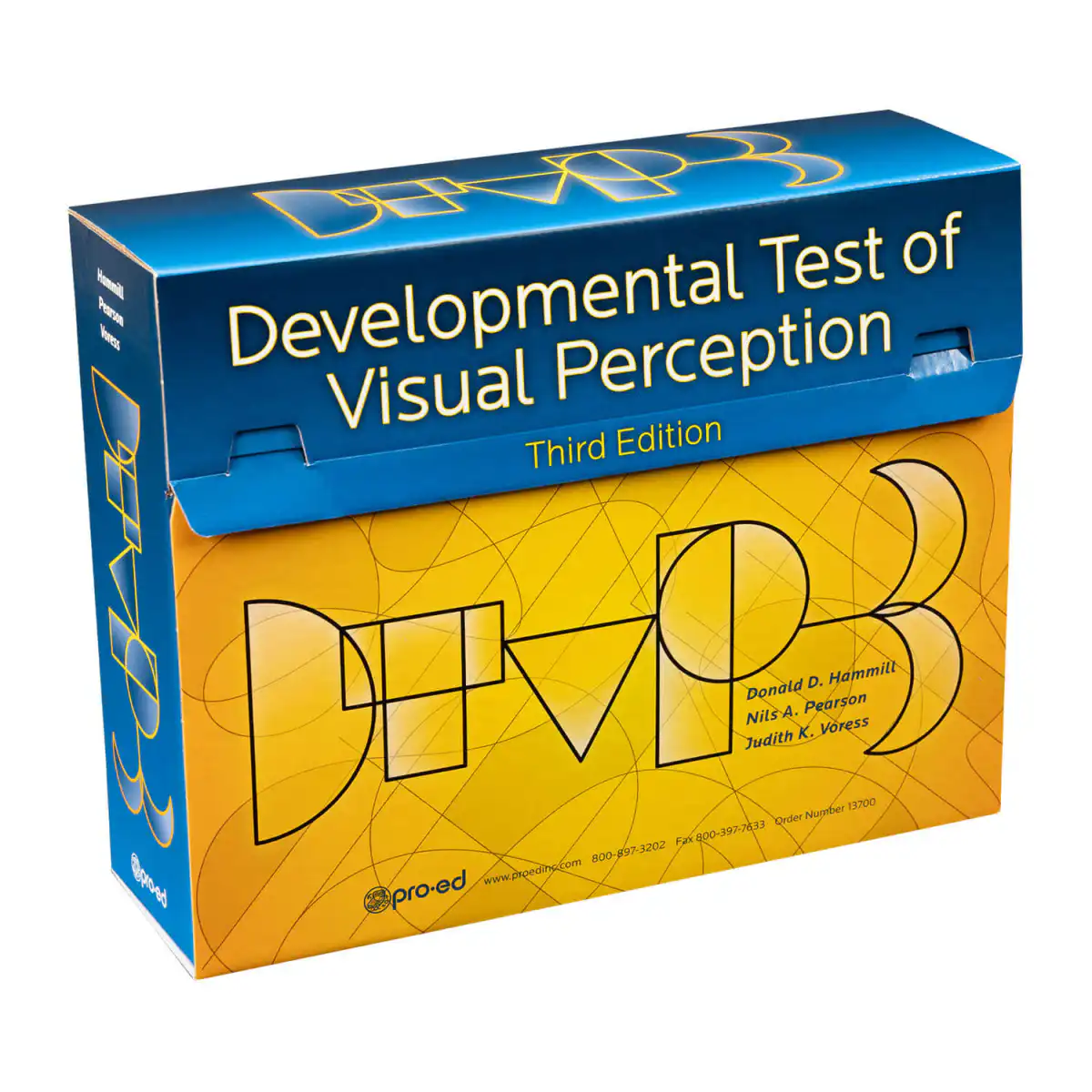
The Developmental Test of Visual Perception (DTVP)
The Developmental Test of Visual Perception (DTVP) suite—specifically the DTVP-3 for children and the DTVP-A:2 for adolescents and adults—has emerged as a rigorous psychometric tool for specialist assessors. Guided by the SpLD Assessment Standards Committee (SASC), this article explores how the DTVP suite provides critical diagnostic evidence for dyslexia and dyspraxia, the nuances of its administration, and why its interpretation must be handled with expert care.
1. Understanding the DTVP-3: A Deep Dive for Early Intervention
The DTVP-3 (Third Edition), published by Pro-Ed, is designed for the 4.0 to 12.11 age range. In the context of dyslexia, where a child may struggle with letter reversals or “losing their place” on a page, and dyspraxia, where handwriting is often labored and messy, the DTVP-3 offers a granular look at the “why” behind these challenges.
The Two Pillars: VMI and Motor-Reduced Perception
The DTVP-3 is unique because it separates tasks that require physical movement from those that do not.
- Visual-Motor Integration (VMI) Composite: This focuses on eye-hand coordination. Subtests include Hand-Eye Coordination (drawing within paths) and Copying. For a child with suspected dyspraxia, these scores are vital. Unlike the Beery-Buktenica VMI, the DTVP-3 lacks overlapping forms in its copying tasks, which can help an assessor isolate whether a child’s struggle is with the complexity of the shape or the physical act of drawing it.
- Motor-Reduced Visual Perception Composite: This is often called the “purest” measure of perception. By removing the need for precise drawing, it identifies if a child’s brain is correctly interpreting visual data.
- Figure-Ground: Finding a shape in a busy background (essential for navigating a textbook).
- Visual Closure: Completing a mental image from fragments (essential for rapid word recognition in dyslexia).
- Form Constancy: Recognizing a shape regardless of its size or orientation (essential for recognizing fonts and handwriting styles).
2. Qualitative Insights: Beyond the Numbers
While the DTVP-3 generates robust psychometric data—scaled scores and percentile ranks—the true value for a dyslexia or dyspraxia specialist lies in qualitative observation.
When a child sits for the 20-30 minute test, an assessor isn’t just marking “right or wrong.” They are looking for:
- Executive Function: Does the child have a methodical approach to the Figure-Ground task, or is it impulsive?
- Visual Memory: Can they hold the image of a shape in their mind long enough to replicate it?
- Persistence: For children with dyspraxia, the physical act of drawing is exhausting. How does their concentration hold up across the subtests?
SASC guidance notes that while the DTVP-3 is child-friendly, assessors must be wary of “unnecessary testing.” The DTVP-3 should be used when there is a clear concern—such as a student who reports visual stress or someone whose handwriting is significantly discrepant from their verbal intelligence.
3. The DTVP-A:2: Assessing Adolescents and Adults
As learners grow, their compensatory strategies often mask the core symptoms of dyspraxia and dyslexia. The DTVP-A:2 (Second Edition) is an invaluable tool for assessing older learners (adolescents and adults) who may still struggle with the mechanical aspects of writing or the organizational aspects of visual information.
In adult SpLD assessments, the DTVP-A:2 often serves as an alternative to the Beery VMI. However, its most debated feature is the Visual-Motor Efficiency (VME) Index.
4. The Processing Speed Debate: DTVP-A:2 vs. SDMT
One of the most critical distinctions made by SASC involves the relationship between the DTVP-A:2 and the Symbol Digit Modalities Test (SDMT). In many dyslexia assessments, the SDMT is used to measure processing speed. There has been a tendency to see the DTVP-A:2’s speed-based subtests as a substitute for the SDMT, but SASC issues a firm warning here.
Simple vs. Complex Processing Speed
The DTVP-A:2 measures what Reynolds calls “simple processing speed” or “perceptual speed.”
- DTVP-A:2 (Visual-Motor Speed): Tasks involve quickly filling boxes with simple shapes. This requires motor speed but low cognitive “load.”
- SDMT (Coding): This requires the learner to match symbols to numbers using a key. This is a complex task involving working memory, attention, and sequencing.
The Diagnostic Takeaway: If a student with dyslexia scores poorly on the SDMT but well on the DTVP-A:2, it suggests their “simple” motor speed is fine, but their ability to process complex, coded information (like phonics and spelling) is the bottleneck. Conversely, a low score on the DTVP-A:2 might point more directly toward the motor-coordination difficulties associated with dyspraxia.
5. Diagnostic Relevance to Dyslexia and Dyspraxia
It is important to remember that the DTVP suite is not a “dyslexia test” or a “dyspraxia test” in isolation. In the original standardization, some individuals with learning disabilities performed within the average range.
Instead, the DTVP provides the underlying evidence of why a student is struggling:
| Finding | Potential Impact on Dyslexia | Potential Impact on Dyspraxia |
| Low Visual Closure | Difficulty recognizing words by sight; slow reading fluency. | Minimal direct impact, but may hinder map reading or geometry. |
| Low Figure-Ground | Losing place while reading; difficulty skimming text. | Difficulty finding tools or equipment in a workspace. |
| Low Eye-Hand Coordination | Messy annotations; difficulty with “bubble” sheets. | Significant struggle with handwriting, drawing, and manual tasks. |
| Low Form Constancy | Difficulty recognizing letters in different fonts/scripts. | Struggle with spatial awareness and 3D modeling. |
6. Best Practices for Reporting and SASC Compliance
When an assessor includes DTVP results in an SpLD report, SASC guidance dictates where and how that information should be placed to ensure clarity for the reader (and for Disabled Students’ Allowance or exam access arrangements).
- Additional Diagnostic Evidence: If the test was used specifically to investigate why a student has “clumsy” motor skills or visual perception issues, the results belong in the section for additional diagnostic evidence.
- Processing Speed Section: If the DTVP-A:2 is used to supplement processing speed data, it must be reported with an explicit caveat. The assessor must explain that it measures simple perceptual speed and does not capture the same cognitive demands as a coding task like the SDMT.
7. Critical Interpretation: The Specialist’s Role
The DTVP suite is technically rigorous, but its utility is only as good as the assessor’s interpretation. A “low” score on visual-motor integration isn’t just a number—it’s a window into the student’s daily frustration.
For the dyspraxic learner, a low VMI score justifies the need for assistive technology like laptops or speech-to-text software, as it proves the physical act of writing is a cognitive drain. For the dyslexic learner, low scores in visual closure or form constancy provide a psychometric basis for why “simple” reading tasks feel so taxing.
Conclusion
The DTVP-3 and DTVP-A:2 are more than just supplementary tests; they are precision instruments that allow SpLD assessors to peel back the layers of a learner’s profile. By separating motor skills from pure visual perception, these tests provide a roadmap for interventions that are tailored to the individual’s specific weaknesses.
However, as SASC emphasizes, there is no room for over-simplification. We must distinguish between simple perceptual speed and the complex processing required for literacy. When used with rigour, training, and critical precision, the DTVP suite ensures that the barriers faced by those with dyslexia and dyspraxia are not just identified, but truly understood.
Quick Reference Summary
- DTVP-3: Best for identifying visual-perceptual vs. motor-integration gaps in children.
- DTVP-A:2: Useful for adolescents/adults, particularly for exploring dyspraxic traits.
- Interpretation Warning: Never use the VME index as a direct 1:1 substitute for the SDMT without explaining the difference in cognitive load.
- Focus: Always relate findings back to how they impact the student’s specific SpLD (e.g., how figure-ground affects reading or how VMI affects handwriting).