

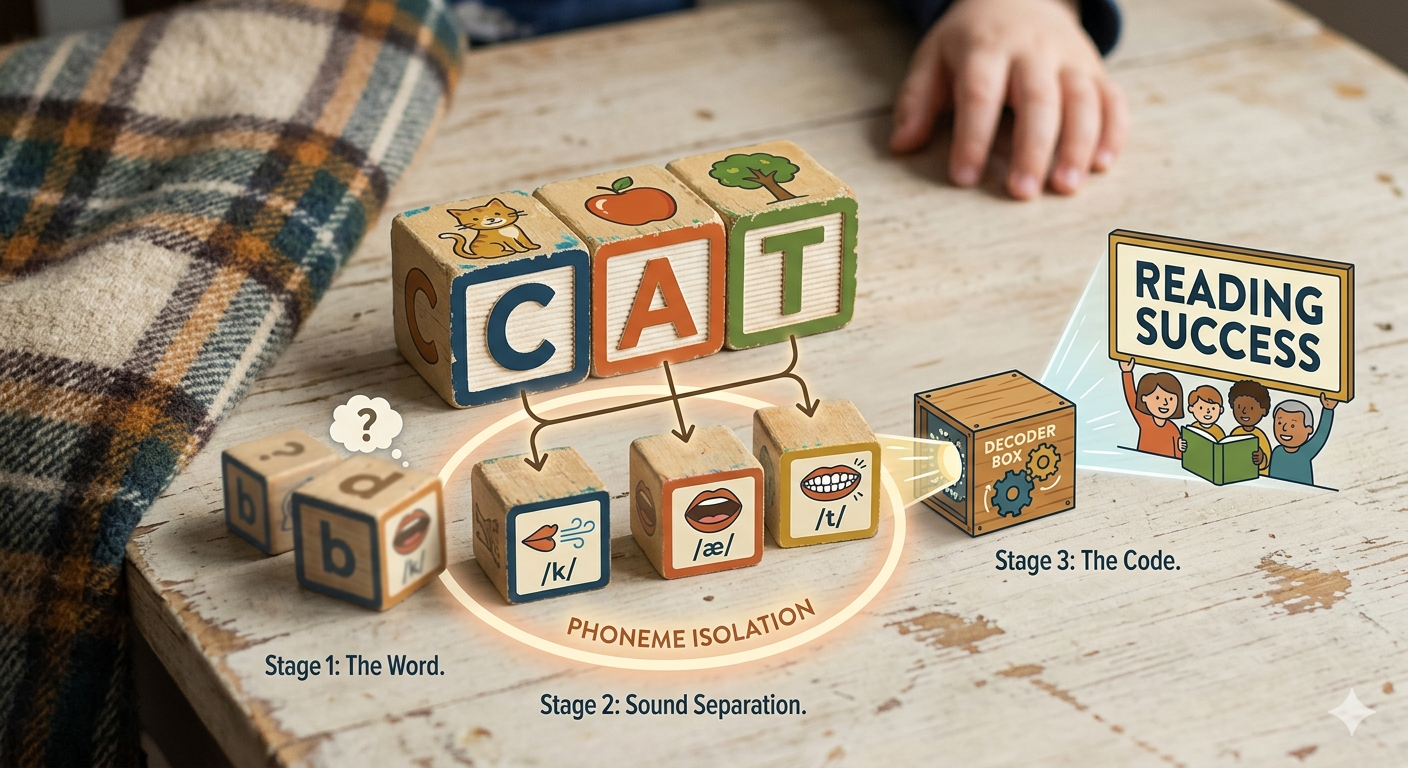
Phoneme Isolation in Dyslexia
When a child or adult struggles with reading, the breakdown often trace back to this specific, foundational skill. For individuals with dyslexia, difficulties with phoneme isolation are not just a minor hurdle they are frequently at the very heart of their literacy challenges.
Understanding what phoneme isolation is, how it manifests in individuals with dyslexia, and how it is assessed can fundamentally change how we support struggling readers.
What is Phoneme Isolation?
Before diving into its connection to dyslexia, it helps to understand what a phoneme is. A phoneme is the smallest individual unit of sound in a spoken language that can distinguish one word from another. For example, the spoken word “cat” is made up of three distinct phonemes: /k/, /æ/, and /t/.
Phoneme isolation is the specific ability to identify and isolate a single sound within a spoken word, pinpointing exactly where that sound occurs (at the beginning, middle, or end).
Phoneme isolation is a core component of phonemic awareness, which sits under the broader umbrella of phonological awareness (the overarching ability to recognize and manipulate larger parts of spoken language, such as syllables, rhymes, and words).
When practicing phoneme isolation, a learner is asked auditory questions such as:
- “What is the first sound you hear in the word ‘sun’?” (Answer: /s/)
- “What is the last sound you hear in the word ‘cup’?” (Answer: /p/)
- “What is the middle sound you hear in the word ‘map’?” (Answer: /æ/)
It is important to note that phoneme isolation is entirely auditory. It does not require looking at letters or reading print; it is strictly about how the brain processes and breaks apart the spoken sounds it hears.
What is “Hominization” in Reading Development?
In discussions of advanced reading development, linguistics, and cognitive processing, you may occasionally encounter concepts related to humanisation (often referred to in structural and cognitive linguistics as linguistic homogenization).
In the context of early literacy and speech processing, “humanisation” refers to the cognitive process where the brain groups, categorizes, and treats slightly different auditory sounds (allophones) as the same core sound (a phoneme).
Human speech is messy and continuous. When people speak, the sound of a letter changes slightly depending on the sounds next to it, the speaker’s accent, or how fast they are talking. A child’s brain must undergo a process of auditory homogenization learning to ignore these tiny acoustic variations and group them into standardized, clean “sound buckets.”
Why is it Important to Dyslexia?
For a typically developing reader, the brain successfully categorizes these sounds. It easily filters out speech clutter, allowing the child to realize that the /t/ sound in “top” and the /t/ sound in “stop” belong to the exact same structural sound family, despite slight physical differences in how they are pronounced.
In individuals with dyslexia, this process often breaks down.
- Blurred Sound Buckets: The dyslexic brain frequently struggles to create clean, distinct auditory categories. Instead of clear, isolated sound profiles, the boundaries between phonemes remain “fuzzy” or overlapping.
- Impact on Mapping: If the brain cannot cleanly categorize or isolate these spoken sounds, it becomes incredibly difficult to complete the next logical step in reading: mapping those sounds onto visual letters (graphemes).
Without successful phoneme categorization and isolation, learning phonics feels like trying to build a house on moving quicksand.
How Phoneme Isolation is Used in Dyslexia Testing
Because phonological deficits are a hallmark characteristic of dyslexia, standard diagnostic protocols heavily evaluate a person’s phonemic awareness skills. Specialists do not just look at how well a person reads a book; they test how the brain processes spoken sounds.
During a professional dyslexia assessment, a specialist will use targeted subtests to measure phoneme isolation. These tests are meticulously structured to track a progression of difficulty:
| Testing Phase | Task Description | Example |
| Initial Sound Isolation | Isolating the very first sound of a simple word. This is usually the easiest task because the sound is prominent. | “What is the first sound in ‘dog’?” → /d/ |
| Final Sound Isolation | Isolating the terminal sound of a word. This requires holding the word in working memory. | “What is the last sound in ‘mat’?” → /t/ |
| Medial Sound Isolation | Isolating the internal vowel sound. This is notoriously difficult for individuals with dyslexia. | “What is the middle sound in ‘lip’?” → /ɪ/ |
What Evaluators Look For
When assessing these components, a specialist is not just looking for a correct or incorrect answer. They are analysing:
- Response Latency (Speed): Does the individual take a long time to mentally retrieve and isolate the sound? Heavy hesitations indicate that the process is not automatic and requires exhausting mental effort.
- Sound Substitution: Does the individual guess a completely different sound, or confuse voiced and unvoiced pairs (like mistaking /b/ for /p/)?
- Chunking Errors: Do they fail to isolate the single phoneme, instead repeating a whole syllable or an onset-rime combination (e.g., saying “da” instead of /d/)?
The Hidden Toll: What Having Difficulty with Phoneme Isolation Looks Like
When someone struggles deeply with phoneme isolation, it cascades into every single aspect of their academic and daily literacy life. If you cannot isolate a sound in your mind, you cannot manipulate it.
Here is what these underlying phonemic difficulties look like in practice for children and adults:
1. Severe Difficulties with Phonics and Decoding
Phonics requires a reader to look at letters, translate them into sounds, and blend those sounds into a word. If a reader cannot isolate sounds auditorily, they cannot link them to a visual symbol. When looking at the word “flat,” they may see the letters but fail to isolate the initial /f/ from the /l/, leading to fragmented, inaccurate decoding or wild guessing based purely on the first letter.
2. Bizarre or Highly Inconsistent Spelling (Encoding)
Spelling is the reverse of reading; it requires a person to hear a word, break it down into its isolated individual sounds, and write down the corresponding letters. Someone with phoneme isolation deficits will frequently omit letters entirely especially vowel sounds or consonants trapped within blends.
- Example: Writing “stmp” for “stamp” because they cannot isolate the short /æ/ sound in the middle, or writing “flog” for “frog” because the internal liquid consonants blur together.
3. Rapid Fatigue and Cognitive Overload
Because their brains have to work twice as hard to separate sounds that others process automatically, individuals with dyslexia experience severe cognitive fatigue. After just fifteen minutes of reading or writing, they may feel entirely drained, leading to frustration, avoidance behaviour, or anxiety surrounding literacy tasks.
4. Poor Reading Fluency and Comprehension
When decoding is slow, halting, and prone to sound errors, reading fluency plummets. Because all of the reader’s mental energy is being used up just trying to isolate and figure out individual words, there is zero working memory left over to actually understand or retain the meaning of the sentence.
Do You Suspect You or Your Child Might Be Dyslexic? Here is the Essential First Step
If you read through the challenges above and recognized yourself, your child, or a student you teach, it is natural to feel a mix of overwhelm and relief. Identifying that a struggle is tied to sound processing is a massive breakthrough.
The single most important first step you can take is to move away from guesswork and get objective data through formal screening.
Why You Should Choose a Dyslexia Screening Test
You do not need to wait months for an expensive, exhaustive clinical evaluation just to find out if you are on the right track. A dyslexia screening test evaluates critical indicators including phonemic awareness, phoneme isolation, working memory, and rapid naming skills to determine if the individual shows a high probability profile for dyslexia.
Getting screened early provides immediate benefits:
- Targeted Intervention: It highlights exactly where the phonological system is breaking down, so you know whether to focus on basic sound isolation, blending, or advanced phonics.
- Peace of Mind: It reframes the struggle. It reminds individuals that they are not “lazy” or “unintelligent” their brains simply process language differently.
- School Accommodations: A screening can serve as primary evidence to initiate conversations with schools for classroom accommodations, such as extra time or assistive reading technology.
Take Action with Indigo Dyslexia
If you are ready to get clear, professional answers from the comfort of your home, the Indigo Dyslexia screening test is designed specifically to guide you forward.
Indigo Dyslexia offers highly accessible, reliable, and evidence-based screening tools tailored to identify the underlying phonological indicators of dyslexia. By analysing core language processing skills, an Indigo screening test delivers a clear profile of your or your child’s learning strengths and vulnerabilities, giving you a definitive roadmap for next steps, targeted interventions, and specialized learning support.
Sound Isolation is the Key to Reading Success
Phoneme isolation is the vital connective tissue between speech and print. For those with dyslexia, a breakdown in isolating these tiny building blocks of language can lock the doors to fluent reading and confident spelling.
However, the brain possesses incredible neuroplasticity. With explicit, systematic, and multi-sensory phonemic awareness training often delivered through structured literacy methodologies individuals can train their brains to build clean sound categories, isolate phonemes accurately, and bridge the gap to successful literacy. Identifying the barrier is half the battle; proper screening is the key that opens the door.