

Why Does My Child Reverse Letters?
Naturally, your mind might jump straight to a burning question: Why does my child reverse letters, and is this an early sign of dyslexia?
Seeing your child mix up ‘b’ and ‘d’ or write sentences in mirror image can feel alarming. In the digital age, a quick internet search can quickly overwhelm you with worst-case scenarios.
This comprehensive guide is designed to deconstruct the science behind letter reversal, explore exactly how it relates to dyslexia, provide actionable strategies to support your child at home, and outline clear next steps including how a professional dyslexia screening test can provide the clarity you deserve.
1. Why does my child reverse letters: Is It Normal?
The short answer is: yes, it is completely normal up to a certain age.
To understand why children reverse letters, we have to look at how the human brain processes the visual world. From an evolutionary standpoint, our brains were built to recognize objects regardless of their orientation.
The Concept of Object Invariance
Think of a coffee mug. Whether the handle faces to the left, to the right, or if the mug is flipped completely upside down, your brain instantly categorizes it as a “mug.” This survival mechanism is known as object invariance. It ensures that a child recognizes a dog whether it is walking left or walking right.
When children learn to read and write, we suddenly ask their brains to unlearn this fundamental rule. For the first time in their development, direction matters entirely:
- A stick with a circle on the right side is a b.
- A stick with a circle on the left side is a d.
- Flip it upside down, and it becomes a p or a q.
For a young child whose visual processing centre is still maturing, this is a massive cognitive leap.
The Age Timeline: When Should It Stop?
During early childhood education (ages 4 to 6), mixing up letters and numbers is an ordinary part of development. The brain is still building the neural pathways required to lock in left-to-right tracking and spatial orientation.
However, a developmental shift typically occurs around age 7 (late Year 2 or early Year 3 in the UK school system). By this stage, most children have developed the visual-spatial maturity to consistently distinguish the orientation of symbols.
The General Rule: If a child is 7 or older and is still frequently reversing letters, switching numbers, or writing from right to left, it transitions from a typical developmental phase to a potential indicator of an underlying learning difference like dyslexia.
2. The Core Connection Between Letter Reversal and Dyslexia
A common misconception is that dyslexia is a visual problem where children physically “see” letters moving or backwards. This is a myth. Dyslexia is fundamentally a phonological processing difference meaning the brain struggles to break down, manipulate, and map the sounds of spoken language to the written symbols (letters) representing them.
So, if dyslexia isn’t a visual issue, why is letter reversal and dyslexia so frequently linked?
How Phonological Processing Affects Letter Orientation
When a neurotypical child writes the word “bat,” their brain quickly recalls the sound /b/, associates it with the letter shape ‘b’, and directs the hand to draw it.
For a child with dyslexia, the connection between the auditory sound and the visual symbol is weak. Because they are working twice as hard to figure out which letter makes the sound, their cognitive load is maxed out. When the brain is exhausted by phonetic decoding, it defaults back to its old habit: object invariance. It throws the shape onto the page without assigning strict rules to which way the loop faces.
Beyond Reversals: Telling the Difference
If your child is mixing up ‘b’ and ‘d’, look closely at the surrounding landscape of their learning. Letter reversal on its own does not equal dyslexia. However, if it co-occurs with other signs, the probability increases significantly.
| Typical Developmental Reversal | Reversal Related to Dyslexia |
| Occurs primarily before the age of 7. | Persists consistently past the age of 7 or 8. |
| The child reads fluently but occasionally writes a letter backwards. | The child struggles significantly with reading fluency and decoding. |
| Reversals happen mostly when the child is tired or writing quickly. | Reversals happen alongside slow, laboured writing and spelling errors. |
| The child easily remembers sight words and rhymes. | The child has severe difficulty identifying rhymes or breaking words into syllables. |
3. Broader Signs of Dyslexia in Children
To understand if your child’s letter reversals point toward dyslexia, it helps to examine their academic and behavioural habits across multiple areas. Dyslexia manifests uniquely in every individual, but it typically shows up across a cluster of specific areas.
Phonological Awareness Difficulties
This is the cornerstone sign of dyslexia. Children may struggle to isolate individual sounds in words. For instance, they might not be able to tell you what sound is left if you take the “s” sound out of “spot.” They may also struggle significantly with rhyming games, frequently missing the rhythmic pattern in simple nursery rhymes.
Reading and Decoding Challenges
Reading often feels exhausting for a dyslexic child. They may read a word correctly on one page, only to completely fail to recognize the exact same word three lines lower down. They often guess words based purely on the first letter or the accompanying pictures, rather than sounding them out phonetically.
Spelling and Writing Hurdles
Spelling is frequently inconsistent. You might find the same word spelled three different ways within a single paragraph. Their writing often appears messy, light, or erratic, because the act of translating thought to physical text requires immense mechanical effort.
Behavioural and Emotional Indicators
Children are acutely aware when they are working harder than their peers for lesser results. As a result, you might notice work avoidance tactics when it is time to read or do homework. They might complain of headaches, act out in class, or express deep frustration, frequently stating, “I’m just stupid” a heartbreaking phrase that signals their self-esteem is taking a hit.
4. Practical Strategies to Stop Letter Reversal at Home
If your child is struggling with spatial orientation, there are evidence-based, multisensory strategies you can use at home to help their brain lock in the correct directions. Multisensory learning involves engaging visual, auditory, and kinaesthetic (movement-based) pathways simultaneously.
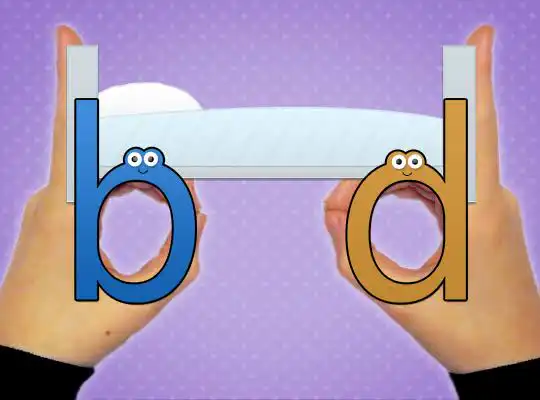
Strategy 1: The “Bed” Trick
This is a classic visual and physical anchor. Teach your child to put their hands in front of them in loose fists with their thumbs pointing up.
- Their left hand forms the shape of a b.
- Their right hand forms the shape of a d.
- Together, their hands create the shape of a bed.
Because the word “bed” starts with /b/ and ends with /d/, they can visually look at their hands to check which way the loop should face when writing.
Strategy 2: Air Writing and Large Muscle Movements
Before writing a letter with a pencil on paper, have your child write it in the air using their entire arm. Trace the letter wildly and largely while saying the sound aloud: “Start at the top, go down, up, and around for /b/.” Engaging large muscle groups creates stronger muscle memory in the brain than fine motor movements of the fingers alone.
Strategy 3: Tactile Tracing
Engage your child’s sense of touch by having them trace letters on textured surfaces. You can create letter cards using sandpaper, or spread a thin layer of shaving cream, sand, or salt onto a baking tray. Have them trace the letter ‘d’ while reinforcing the pathway verbally: “Around the doorknob, up to the ceiling, down to the floor.”
Strategy 4: Continuous Stroke Writing
Many children reverse letters because they lift their pencil off the page, lose their place spatially, and place the circle on the wrong side. Encourage continuous stroke writing. For a ‘b’, teach them to go down, up, and around without ever lifting the pencil off the page. This distinct physical movement feels entirely different from writing a ‘d’, which begins with an around, up, and down motion.
5. The Vital Importance of Early Intervention
When parents notice continuous letter reversals, a common piece of advice they receive from well-meaning friends or teachers is to “wait and see.” While it is true that children develop at different rates, modern educational psychology heavily favours proactive intervention over passive waiting.
Waiting too long can have cascading consequences. When a child falls behind in reading in the early years of school, the gap between them and their peers expands exponentially over time. This phenomenon is known in educational circles as the Matthew Effect (the rich get richer, and the poor get poorer). In reading terms, children who read well enjoy reading, read more, and expand their vocabulary rapidly. Children who struggle read less, fall further behind, and begin to dislike school.
Furthermore, the emotional toll of unaddressed learning differences can be profound. Long before an official academic gap opens up, a child may experience chronic anxiety, school refusal, and a deeply diminished sense of academic self-worth. By intervening early, you protect your child’s mental well-being and ensure they receive the tailored accommodations they need to thrive.
6. If You Suspect Dyslexia: The Essential First Step
If your child is past their seventh birthday, continues to reverse letters, and shows any of the accompanying signs of reading or spelling struggles, it is time to transition from home remedies to professional insight.
Why You Should Start with a Screening
The definitive first step in this journey is to seek out a professional dyslexia screening test.
A screening test is a targeted assessment designed to analyse a child’s cognitive profile. It looks at their phonological processing speed, working memory, rapid naming skills, and visual-spatial processing. Instead of a simple pass-or-fail metric, a screening provides a comprehensive look at your child’s specific learning profile, highlighting both their core vulnerabilities and their unique cognitive strengths.
Receiving an early screening offers several vital advantages:
- Targeted Teaching: It tells educators exactly where the breakdown in communication is happening, allowing them to implement structured literacy interventions.
- School Accommodations: It opens the door for vital classroom adjustments.
- Emotional Relief: Most importantly, it changes the internal narrative for your child. It transforms their self-perception from “I am bad at this” to “My brain just learns differently, and now we know how to help it.”
The Indigo Dyslexia Centre
When looking for a specialist to guide you through this process, providers such as The Indigo Dyslexia Centre specialize in offering accessible, high-quality dyslexia screening tests.
Summary: A Journey of Support, not a Diagnosis of Limitation
Discovering why your child reverses letters is the first step toward unlocking their full potential. Remember that dyslexia has absolutely zero correlation with intelligence. In fact, individuals with dyslexia are frequently highly creative, exceptional three-dimensional thinkers, and natural problem solvers.
By staying observant, practicing multisensory techniques at home, and seeking out an dyslexia screening test, you are giving your child the ultimate tool for academic and personal success: the gift of understanding how their beautiful, unique brain works.