

A Critical Guide to the EVT-3 for Dyslexia Specialists
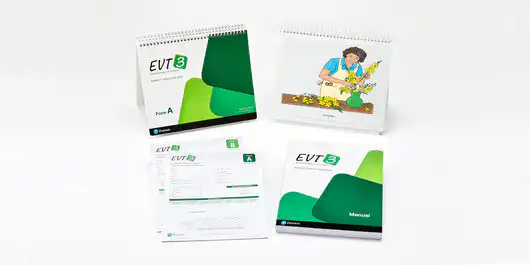
The Expressive Vocabulary Test, Third Edition (EVT-3), published by Pearson and authored by Kathleen T. Williams, PhD, is a premier tool for measuring this specific skill. However, for UK-based practitioners, using this US-normed instrument requires a nuanced understanding of its strengths and its “transatlantic” limitations.
In this article, we explore the utility of the EVT-3 specifically through the lens of dyslexia assessment and intervention.
Why Expressive Vocabulary Matters in Dyslexia
Dyslexia is fundamentally a language-based learning difference. While often associated with reading, it frequently co-occurs with Rapid Automatized Naming (RAN) deficits and word-finding difficulties. A student may “know” a word but be unable to retrieve it quickly during a writing task or a classroom discussion.
The EVT-3 targets this gap. By requiring a single-word response within a strict ten-second time limit, it pressures the lexical retrieval system, providing a clear window into how efficiently a learner can access their stored vocabulary.
Test Structure: A Lifespan Approach
The EVT-3 is an individually administered, norm-referenced test with an impressive age range: 2 years 6 months to 90+ years. This makes it an invaluable tool for:
- Early Years: Identifying language delays that may be early indicators of dyslexia.
- Adolescence: Assessing the impact of limited “word wealth” on secondary school essays.
- Adults: Evaluating workplace communication challenges related to neurodiversity.
The test utilizes two parallel forms (Form A and Form B), which is a significant advantage for specialists monitoring the impact of specific vocabulary interventions over time.
The Power of Qualitative Analysis in Dyslexia Profiles
One of the EVT-3’s standout features is its move beyond a simple “raw score.” It allows for a granular, qualitative breakdown of an individual’s vocabulary profile. This is crucial for dyslexic learners who often have “spiky” profiles.
1. Home vs. Curriculum vs. STEM Vocabulary
The EVT-3 categorizes words based on where they are likely learned:
- Home/Conversation: Words picked up through daily life.
- School/Curriculum: Words typically learned through formal instruction.
- Enriched/STEM: Technical vocabulary (Science, Technology, Engineering, and Math).
The Dyslexia Connection: Many dyslexic students have high “Home” vocabulary scores due to strong oral language environments but may lag in “School/Curriculum” or “STEM” vocabulary because they struggle to engage with text-heavy learning materials. Identifying this gap allows for targeted support in subject-specific terminology.
2. Parts of Speech Analysis
The test analyzes whether a learner struggles more with Nouns, Verbs, or Attributes. If a dyslexic student can identify objects (nouns) but fails to retrieve action words (verbs), it points toward a specific linguistic processing deficit rather than a general lack of knowledge.
Challenges for UK Practitioners
While the EVT-3 is methodologically robust, UK assessors must navigate several hurdles highlighted by the STEC (SASC Test Evaluation Committee) Guidance.
The “Americanism” Barrier
As an American-standardized test, the EVT-3 includes “Americanisms”—words or cultural references that may not be familiar to a British child. Examples might include specific terms for clothing, food, or household items.
Practitioner Tip: Use clinical judgment. If a student fails an item due to a cultural mismatch rather than a vocabulary deficit, it must be noted in the qualitative report to ensure the final score isn’t unfairly skewed.
The Missing Piece: The PPVT-5
In the US, the EVT-3 is co-normed with the Peabody Picture Vocabulary Test, Fifth Edition (PPVT-5), which measures receptive vocabulary (understanding words heard).
Comparing the two is the “gold standard” for diagnosing word-retrieval issues:
- High Receptive / Low Expressive: Classic word-finding/retrieval difficulty (common in dyslexia).
- Low Receptive / Low Expressive: A broader language impairment or lack of exposure.
The Problem: The PPVT-5 is not currently available in the UK. This prevents practitioners from making a statistically validated comparison, forcing them to rely on other receptive measures that may not be perfectly aligned with the EVT-3.
Cognitive Overlap and Numeracy
Practitioners should be wary of the “order of testing.” Some EVT-3 items mirror verbal reasoning tasks in the Wide Range Intelligence Test (WRIT). Administering the EVT-3 immediately after the WRIT may lead to “priming,” where the student’s brain is already activated for those specific tasks, potentially inflating the score.
Summary: Is the EVT-3 Right for Your Practice?
The EVT-3 is a demanding, high-level assessment that offers more than just a percentile rank. For the dyslexia specialist, it provides a roadmap of where a student’s lexical “filing system” is breaking down.
Pros and Cons for UK Use
| Feature | Strength | Consideration for UK |
| Age Range | 2.6 to 90+ years | Broadly applicable. |
| Time Limit | 10 seconds (evaluates retrieval) | Can be stressful for some learners. |
| Qualitative Data | Home/School/STEM breakdowns | Excellent for intervention planning. |
| Cultural Context | Modern 2019 norms | Contains Americanisms. |
| Co-norming | Designed to work with PPVT-5 | PPVT-5 is unavailable in the UK. |
Conclusion
The Expressive Vocabulary Test, Third Edition remains an indispensable tool for identifying expressive language challenges that often underpin dyslexia. While the lack of a co-normed receptive measure and the presence of American cultural items require a cautious approach, the depth of qualitative data it provides is unmatched. By applying clinical judgment and focusing on the “School/STEM” vs. “Home” vocabulary split, UK practitioners can gain vital insights into a learner’s literacy journey.