

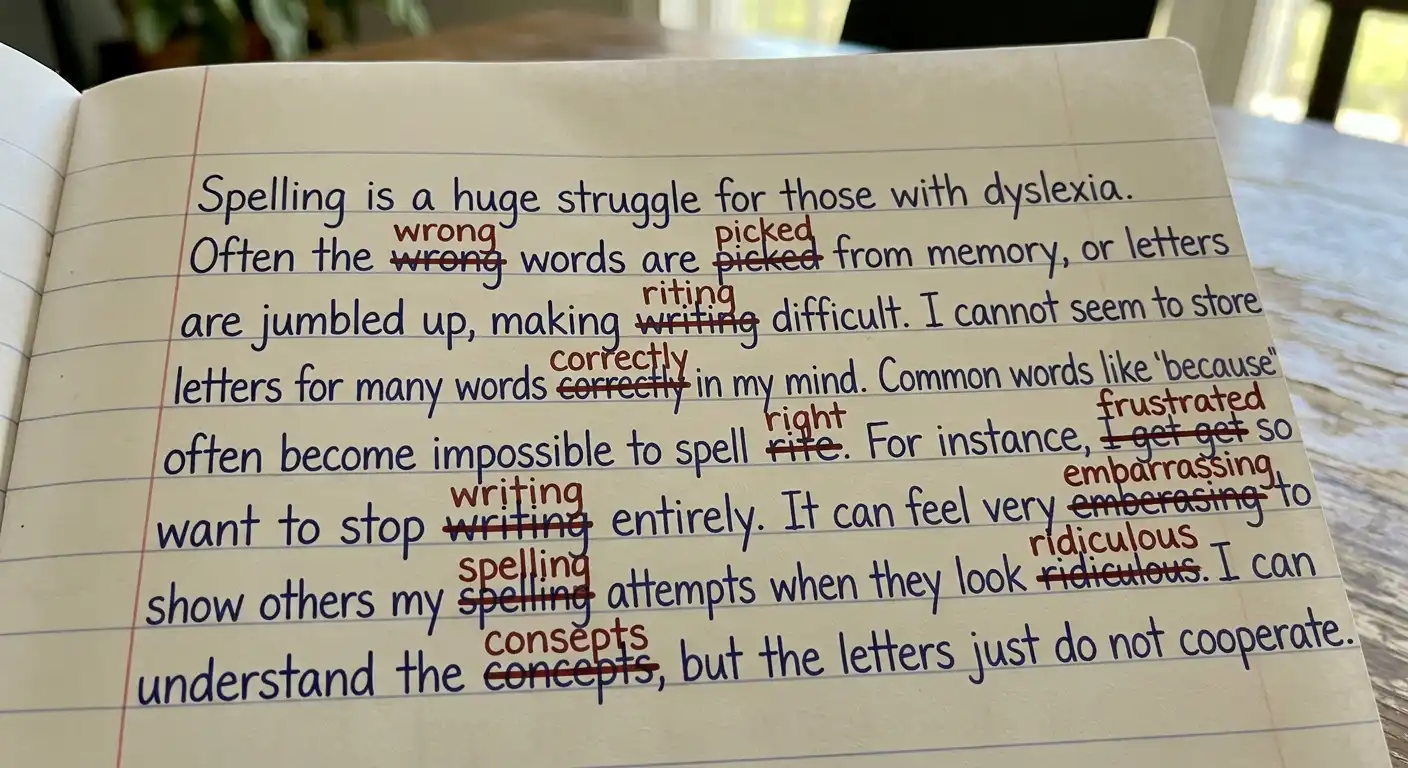
Dyslexia and Spelling
If this sounds familiar, you are not alone. Spelling difficulties are one of the most persistent markers of dyslexia. Crucially, a struggle with spelling has nothing to do with intelligence, effort, or language ability. It is rooted in how the brain processes written symbols and language sounds.
Understanding the direct connection between dyslexia and spelling is the first step toward overcoming the daily frustration it causes. This guide explores why spelling presents such a unique challenge for dyslexic minds, highlights key signs across different age groups, outlines actionable strategies, and details the essential first steps to take if you suspect you or someone you care about may be dyslexic.
1. Why Does Dyslexia Affect Spelling So Strongly?
To understand why dyslexia impacts spelling, it helps to examine what the brain actually does when writing down a word.
Spelling is a complex cognitive task. It requires your brain to retrieve stored visual representations of words while simultaneously breaking spoken sounds down into their matching letters or letter combinations. For neurotypical individuals, this process becomes largely automatic over time. For individuals with dyslexia, the neural pathways involved in this processing function differently.
Phonological Processing Deficits
At the heart of dyslexia lies a difference in phonological processing the ability to identify, manipulate, and isolate individual sounds (phonemes) within spoken words. When spelling, a person must segment a word into distinct sounds and map those sounds to the correct written letters (graphemes).
If phonological processing is impaired, hearing the subtle differences between sounds or holding those sounds in short-term memory long enough to write them down becomes an intense mental workout. A word like blend might end up written as bed or bled simply because the internal sound-mapping skipped a letter.
Working Memory Constraints
Spelling requires robust short-term working memory. When writing a sentence, you must simultaneously:
- Remember the overall thought you wish to express.
- Recall the specific words you need.
- Hold the sound sequence of each word in mind.
- Apply complex spelling rules.
- Perform the physical motor actions of typing or handwriting.
Because dyslexic individuals often expend significant mental energy just identifying individual letter-sound matches, their working memory becomes overloaded. As a result, letters get omitted, word endings are dropped, or entire sentences lose structural coherence.
Orthographic Memory and Visual Sequence Recall
English is a notoriously irregular language. Words like knight, cough, and thorough cannot be spelled purely phonetically; they rely on orthographic memory the brain’s mental dictionary of visual word patterns.
Dyslexic individuals frequently struggle to retain these visual snapshots of words. While a non-dyslexic reader builds a quick visual memory of a word after seeing it a few times, a dyslexic reader may need dozens or even hundreds of exposures before the pattern locks into long-term memory. Without that stored visual image, spelling becomes a constant process of guessing.
2. Common Signs of Dyslexia in Spelling
Dyslexia manifests differently depending on age, education level, and individual coping mechanisms. However, specific patterns in spelling often signal underlying dyslexic traits.
In Children
- Inconsistent Spelling: Spelling a word correctly at the top of a page, only to spell it three different ways by the bottom of the same sheet (e.g., said, sed, sayd).
- Letter Transpositions: Reversing letters within words, such as writing from instead of form, or swapping letters with similar shapes like b, d, p, and q.
- Omission of Unstressed Syllables: Leaving out middle letters or quiet sounds, such as writing remember as rember.
- Phonetic-Only Spelling: Relying purely on how words sound, missing silent letters entirely (e.g., nite for night, dun for done).
- Slow Writing Speed: Spending an unusual amount of time on short writing tasks due to the sheer effort required to spell basic words.
In Adults
- Reliance on Simpler Vocabulary: Deliberately choosing basic, easy-to-spell words in written communication to avoid making errors, even when possessing a rich verbal vocabulary.
- Heavy Dependence on Technology: Total reliance on spell-check, dictation tools, or predictive text to draft routine messages or work documents.
- Frequent Typos and Transpositions: Consistently mis-keying letter orders in emails, particularly when writing under time pressure.
- Avoidance of Writing Tasks: Feeling intense anxiety about filling out paper forms, writing on whiteboards in meetings, or taking handwritten notes in front of colleagues.
- Discrepancy Between Spoken and Written Ability: Demonstrating clear, highly articulate verbal communication, but producing written work that appears disorganized or full of basic spelling mistakes.
3. The Emotional and Practical Impact of Spelling Struggles
The impact of spelling difficulties extends far beyond academic marks or workplace correction notes. For many, spelling challenges carry a heavy emotional toll.
School and Academic Anxiety
From early childhood, dictation tests and marked essays make spelling performance highly visible. Children who regularly fail spelling tests despite studying for hours often internalize a feeling of inadequacy. They may conclude they are “not smart,” leading to classroom anxiety, low self-esteem, and behavioural withdrawal.
Professional and Workplace Challenges
In professional environments, written communication is often treated as a measure of competence and attention to detail. Adults with unmanaged dyslexia may face unfair assumptions about their professionalism or capability due to spelling errors in emails or reports. This can result in:
- Passing up promotions that involve increased administrative duties.
- Spending hours proofreading simple correspondence.
- Experiencing chronic stress and burnout from masking writing difficulties.
Understanding that these challenges stem from neurological processing differences rather than a lack of capability is transformative. It shifts the narrative from internal frustration to proactive management.
4. Think You Might Be Dyslexic? Your Essential First Step
If the signs and descriptions outlined above resonate with your personal experience or that of your child it is completely natural to seek clarity.
Why a Screening Test is Your First Step
If you suspect that you or your child might be dyslexic, your absolute first step should be to undertake a dyslexia screening test.
A screening test is an accessible, preliminary assessment tool designed to identify traits, indicators, and risk factors associated with dyslexia. While a screening test is not a full formal diagnostic diagnosis, it plays a vital role in your journey:
- Immediate Clarity: A screening test gives you immediate, objective insights into whether you’re spelling and reading difficulties match the typical profile of dyslexia.
- Identifies Specific Strengths and Weaknesses: Screening tools evaluate specific areas such as visual processing, auditory discrimination, and working memory helping you pinpoint exactly where processing breaks down.
- Saves Time and Directs Next Steps: A comprehensive formal diagnostic assessment can be a significant financial and logistical commitment. A screening test acts as a reliable filter, showing whether proceeding to a full formal evaluation is recommended.
- Unlocks Early Support: Identifying risk indicators via a screening test allows parents, educators, and adults to begin implementing accommodations, practical strategies, and supportive technologies right away, rather than waiting months for formal appointments.
Taking a structured screening test transforms vague frustration into actionable data. It provides the clarity needed to advocate for appropriate adjustments at school, in higher education, or in the workplace.
5. Proven Strategies to Improve Spelling with Dyslexia
While dyslexia is a lifelong neurological profile, structured techniques can dramatically improve spelling accuracy and confidence. Traditional rote memorization (simply writing a word 20 times) rarely works for dyslexic learners. Instead, strategies must engage multiple sensory channels simultaneously.
Multisensory Structured Literacy Methods
Multisensory approaches engage sight, sound, movement, and touch to build stronger neural connections for spelling patterns.
- VAK (Visual, Auditory, Kinaesthetic) Tracing:
Say the word aloud, sound out the individual phonemes, and trace the letters in large movements (in the air, on a textured surface, or on a whiteboard). Combining physical movement with visual and auditory input reinforces memory pathways.
- Color-Coded Syllables:
Break longer words into manageable syllables, writing each syllable in a different colour (e.g., fan–tas–tic). This reduces working memory load by chunking complex words into smaller components.
- Simultaneous Oral Spelling (SOS):
Read the word, say the word, name each letter individually as you write it down, and then read the completed word back aloud.
Morphological Awareness: Decoding Word Roots
Instead of memorizing thousands of individual words, focus on morphology—the study of word roots, prefixes, and suffixes.
Over 60% of English words have Greek or Latin roots. Understanding how words are constructed allows spellers to apply logical rules rather than relying on visual memory alone:
| Prefix / Root | Meaning | Example Word | Spelling Insight |
| Un- | Not / Opposite | Unnecessary | Keeps both ‘n’s: un + necessary |
| Dis- | Apart / Away | Disappoint | Single ‘s’, double ‘p’: dis + appoint |
| Bio | Life | Biology | Root remains unchanged across words |
| Graph | Write | Autograph | Sound /f/ is written as ‘ph’ in Greek roots |
Visual Mnemonics and Memory Hooks
For irregular words that do not follow standard phonetic rules, creative visual hooks and acronyms can bypass phonological barriers:
- BECAUSE: Big Elephants Can Always Understand Small Elephants.
- NECESSARY: One Collar, two Sleeves (1 ‘c’, 2 ‘s’s).
- SEPARATE: There is A RAT in separate.
6. Leveraging Assistive Technology for Spelling Support
Modern technology has transformed how individuals with dyslexia navigate daily writing tasks. Embracing tech tools removes mechanical friction, allowing creative and analytical thinking to shine without being hindered by spelling barriers.
- Speech-to-Text (Dictation): Tools built into modern operating systems allow users to speak their thoughts directly onto the screen. This bypasses working memory bottlenecks and allows writers to draft content fluidly without stopping over tricky spellings.
- Context-Aware Spell Checkers: Traditional spell-checkers often fail dyslexic users because severely misspelled words produce irrelevant correction lists. Advanced software uses contextual awareness to predict intended words even when phonetic attempts are far off target.
- Text-to-Speech Proofreading: Having your written text read back to you by a synthetic voice makes spelling errors, omitted words, and awkward phrasing instantly apparent to your ear, relying on auditory strength rather than visual proofreading.
7. Supporting a Child or Adult with Dyslexic Spelling Needs
If you are supporting a student, family member, or colleague with dyslexia, your approach can make a profound difference in their confidence and progress.
For Parents and Educators
- Focus on Ideas First, Mechanics Second: When reviewing written work, praise the depth of ideas, story structure, and creativity before addressing spelling errors.
- Limit Corrections: Avoid marking every single misspelled word on a page with red ink, as this leads to frustration. Choose two or three target spelling patterns to focus on per week.
- Provide Explicit Phonics Instruction: Ensure reading and spelling instruction is systematic, explicit, and structured, rather than relying on contextual guessing.
For Workplace Allies and Managers
- Offer Written Accommodations: Allow team members to use dictation software, spell-checking extensions, and proofreading tools on work devices.
- Provide Notes in Advance: Circulate meeting agendas, slides, and briefing documents ahead of time so individuals have time to digest written material.
- Focus on Content Quality: Evaluate written work on clarity, accuracy of facts, and strategic insight rather than penalizing minor typographical errors in internal drafts.
Summary: Moving Forward with Confidence
Struggling with spelling does not mean you are bad at language, nor does it define your potential. Dyslexia simply means your brain processes written sounds and visual symbols in a unique, non-standard way.
By understanding the underlying causes of dyslexic spelling difficulties, adopting multisensory learning strategies, utilizing supportive technology, and creating encouraging environments, individuals with dyslexia can fully express their ideas and thrive.
If you suspect that dyslexia may be playing a role in your own spelling challenges or those of a child or family member do not leave it to guesswork. Taking a reliable dyslexia screening test is your critical first step. Gaining clear insight into your learning profile unlocks the tools, support, and confidence needed to master spelling and succeed in every aspect of life.