

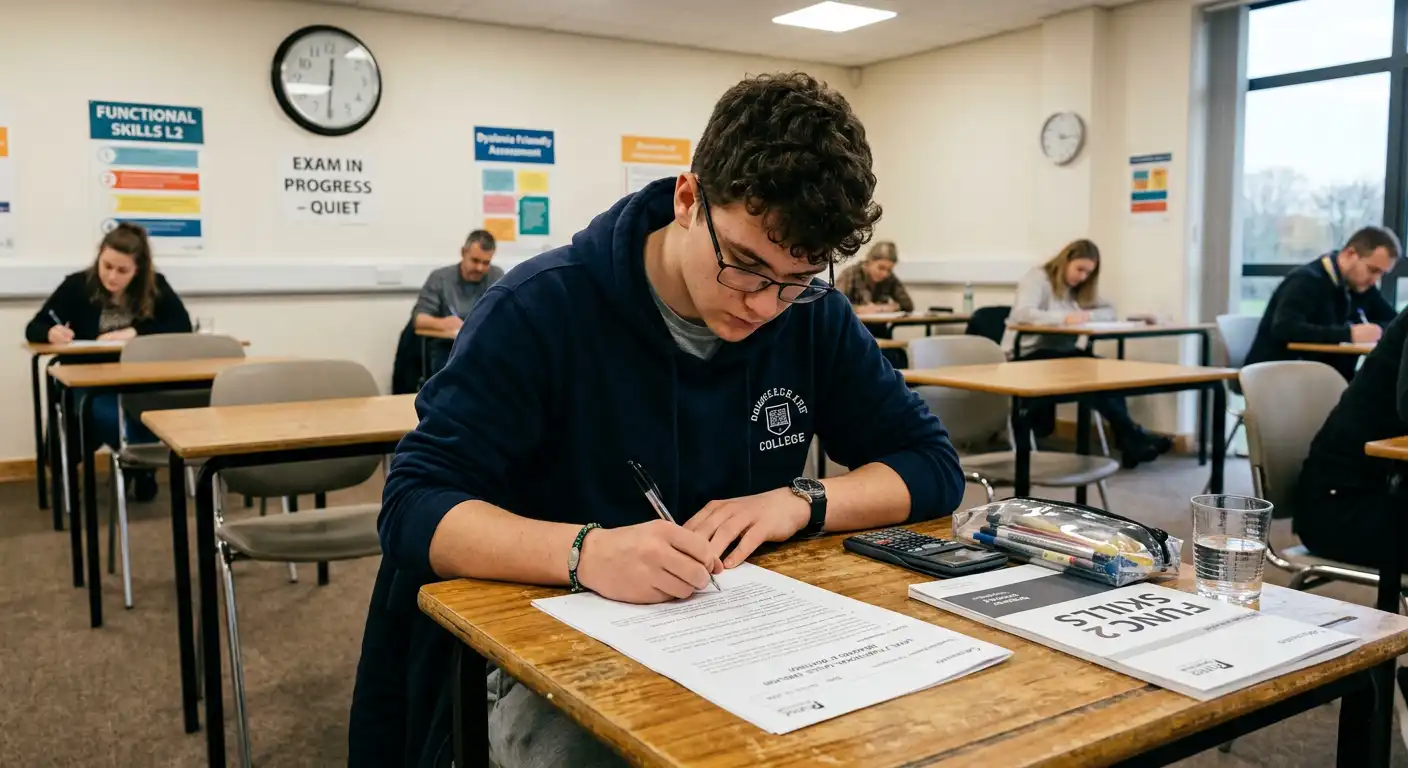
Functional Skills and Dyslexia
For a dyslexic student, missing that crucial grade 4 gateway rarely reflects a lack of intelligence or capability. Instead, it exposes a fundamental flaw in how we assess learning. Traditional GCSEs are often less about what a student knows and more about whether they can process dense blocks of text, retain abstract formulas, and write rapidly under intense exam pressure.
Fortunately, there is a nationally recognised, highly practical alternative: Functional Skills qualifications.
What Are Functional Skills?
Functional Skills are government-regulated qualifications in English, mathematics, and Information and Communication Technology (ICT) designed to assess real-world capability. Unlike traditional GCSEs which lean heavily on abstract concepts, literary analysis, and memory retrieval Functional Skills focus on practical application.
They ask a straightforward question: Can this person apply literacy and numeracy in everyday life and the workplace?
Functional Skills are offered at multiple tiers:
- Entry Levels (1, 2, and 3): Build core foundational skills in reading, writing, speaking, and basic arithmetic.
- Level 1: Roughly equivalent to a GCSE grade 1 to 3 standard.
- Level 2: Nationally recognised as equivalent to a GCSE Grade 4 / Grade C pass.
A Level 2 Functional Skills qualification opens doors to further education courses, university places, apprenticeships, and job opportunities.
Why Do Functional Skills Suit Dyslexic Learners?
Dyslexia is a neurodevelopmental difference that primarily affects phonological processing, working memory, and processing speed. In a standard GCSE English or maths exam, these exact areas are pushed to their absolute limits.
Functional Skills assessments present a far fairer playing field for dyslexic minds:
- Applied Contexts Over Abstract Theory: Instead of analysing 19th-century literature or solving complex theoretical equations, Functional Skills tasks reflect practical scenarios such as calculating a household budget, reading a train timetable, or writing a professional email. Dyslexic thinkers excel at visual, practical, and big-picture problem-solving.
- Reduced Memory Load: Questions are structured around clear, real-life problem solving rather than requiring students to memorise lengthy formulas or quotes.
- Clearer Presentation: Exam papers are formatted to reduce visual clutter, avoiding the dense, overwhelming text blocks common in GCSE papers.
- Criterion-Based Assessment: Functional Skills use criterion-referenced marking. A learner is judged on whether they can demonstrate a specific skill, not graded on a bell curve against every other student in the country.
- Outcome Differences: While the GCSE resit pass rate for post-16 learners hovers around 15% to 20%, pass rates for Level 2 Functional Skills sit around 60% in maths and 80% in English. Same student, different format, vastly different outcome.
What Are the Rules Surrounding Functional Skills?
Understanding the regulatory framework helps parents, adult learners, and students navigate their options effectively:
| Rule Category | Details & Standards |
| GCSE Equivalence | Level 2 is widely accepted as equivalent to GCSE Grade 4 for apprenticeships, FE colleges, and employers. (Note: Always verify specific entry criteria for specialized university degree courses.) |
| Post-16 Funding Rules | Under Department for Education (DfE) guidelines, post-16 students who achieve a GCSE Grade 2 or below can move straight to Functional Skills. Those with a Grade 3 are usually required to resit the GCSE first, though exemptions exist. |
| Exam Board Regulation | Functional Skills are regulated by Ofqual and awarded by major bodies including City & Guilds, Pearson Edexcel, NCFE, and Highfield. |
| On-Demand Testing | Unlike GCSEs, which occur once a year in May/June, Functional Skills exams can be taken year-round on demand, digitally or on paper. |
Access Arrangements: Extra Support for Dyslexic Learners
Functional Skills assessments allow for robust Access Arrangements to ensure dyslexic candidates are not unfairly disadvantaged. Depending on the learner’s assessed profile, these may include:
- 25% Extra Time to compensate for slower processing speeds.
- Text-to-Speech / Screen Readers for reading components (where permitted by exam board rules).
- Computer Readers or Human Readers.
- Scribes or Speech-to-Text Software for writing assessments.
- Coloured overlays or modified paper fonts to alleviate visual stress.
Access arrangements do not lower the standard of the qualification; they simply remove the physical and cognitive barriers to demonstrating ability.
The Fairer Exams Campaign: Fighting for Systemic Change
While Functional Skills offers a vital lifeline, accessing it is not always straightforward. That is where the Fairer Exams campaign comes in.
Founded by campaigner Hannah Gee after watching her dyslexic son repeatedly miss a GCSE pass mark by a single point, the parent-led Fairer Exams movement highlights a staggering reality: 1 in 3 young people leave school without a Grade 4 pass in GCSE English and maths a figure that leaps to 7 in 10 for pupils with Special Educational Needs (SEND).
What is the campaign calling for?
- Earlier Access: Allowing schools to offer Functional Skills pathways as early as Year 10, rather than forcing neurodivergent pupils through a cycle of predicted GCSE failure first.
- League Table Parity: Reforming school performance metrics so schools are not penalized for putting students on a Functional Skills route that suits their learning style.
- An Applied GCSE Option: Embedding practical, Functional Skills-style assessment into GCSE Foundation papers so every child gets a fair chance to reach Grade 4.
- Employer Awareness: Educating businesses so they recognize and value Functional Skills qualifications alongside traditional GCSEs.
How Do You Access Functional Skills?
Getting started with Functional Skills depends on your current stage of education or employment:
- At School or College (Ages 16–19): Speak directly to your school’s SENCo (Special Educational Needs Coordinator) or college exams officer. Ask about switching from a GCSE resit track to a Level 1 or Level 2 Functional Skills course.
- Apprenticeships: Training providers routinely deliver Functional Skills English and maths alongside job-specific training as part of the apprenticeship standard.
- Adult Education & Independent Centres: Adult education colleges, local training providers, and registered online exam centres offer flexible, self-paced Functional Skills courses with remote invigilation options.
Suspect You Might Be Dyslexic? Start with a Screening Test
Many adults and young people navigate the education system feeling frustrated, capable in life, yet consistently struggling with written exams without ever receiving a formal explanation.
If you or your child regularly struggles with reading stamina, spelling consistency, slow processing, or organized writing under timed conditions, dyslexia could be the underlying reason.
The crucial first step is to undertake a professional Dyslexia Screening Test.
A screening test is a quick, accessible evaluation that identifies indicators of dyslexia and maps out cognitive strengths and weaknesses.
- Why screen early? An initial screening provides fast clarity without waiting months for a full diagnostic assessment.
- Unlock Support: Identifying your profile allows educational providers and workplace managers to put tailored support, assistive technology, and exam access arrangements into action immediately.
Taking a screening test transforms frustration into understanding, helping you step off the treadmill of exam resits and onto a functional pathway designed for the way your brain naturally works.