

Multi-Sensory Learning and Teaching for Dyslexia
When a dyslexic individual faces a wall of black-and-white text or a lengthy verbal explanation, their neural pathways can experience information bottlenecks. This is where multi-sensory learning for dyslexia steps in as a transformative, scientifically validated intervention. By engaging multiple senses simultaneously visual, auditory, kinaesthetic, and tactile multi-sensory teaching methods create alternative neural pathways for learning, turning abstract concepts into concrete, memorable experiences.
In this comprehensive guide, we will dive deep into the world of multi-sensory education. We will explore the cognitive science behind why it works, outline specific strategies you can implement immediately, and explain how to identify if you or a loved one could benefit from these approaches via a professional dyslexia screening test at Indigo Dyslexia.
What is Multi-Sensory Learning?
At its core, a multisensory approach dyslexia intervention involves using more than one sense at a time to teach a concept. Traditional teaching relies on the visual channel (looking at letters) or the auditory channel (hearing a teacher pronounce a word). Multi-sensory teaching deliberately links these two channels with kinaesthetic (movement) and tactile (touch) pathways. This holistic approach is often formalized under the umbrella of the Orton-Gillingham approach, which has stood as the gold standard for dyslexia remediation for nearly a century.
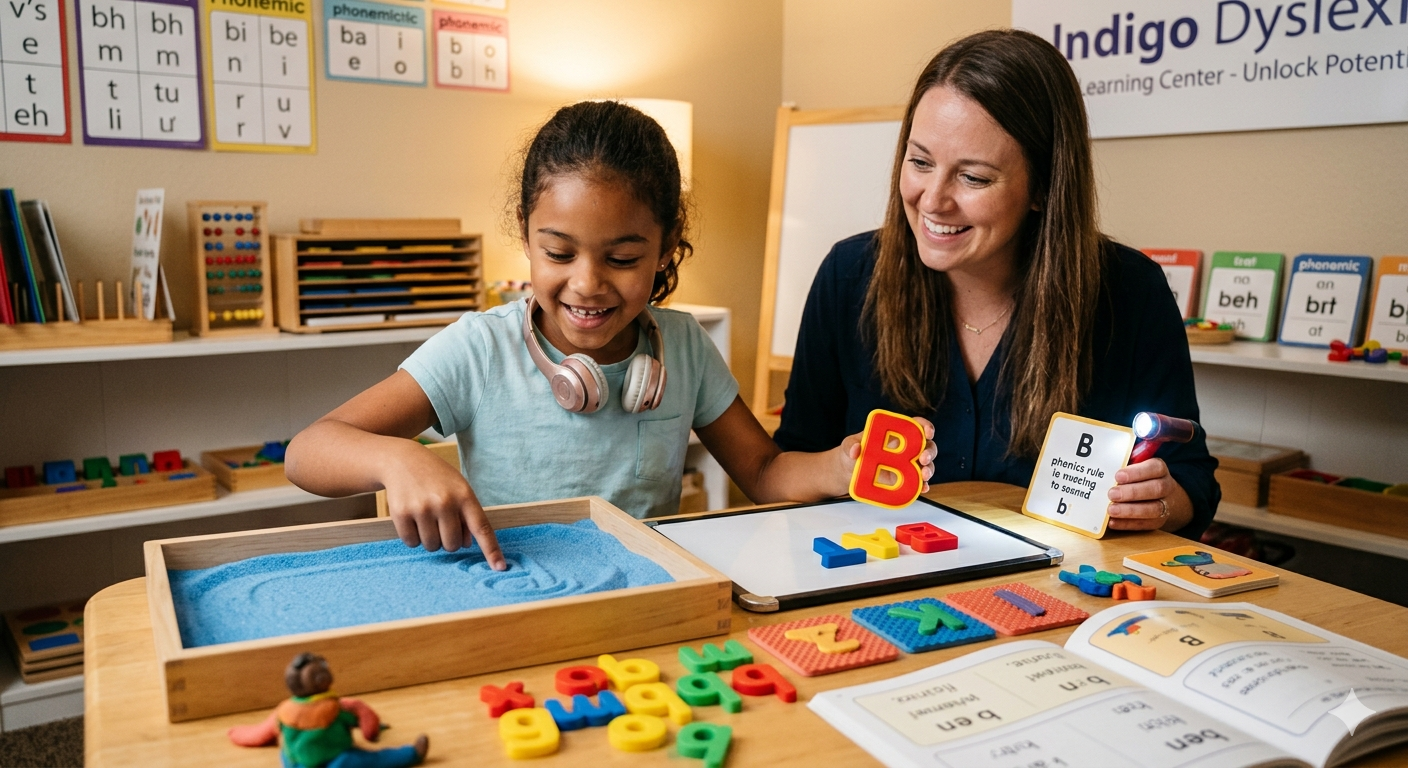
When a student uses multiple senses simultaneously, they are using different parts of their brain at once. For example, when learning the phoneme /b/, a student might look at the letter ‘b’ (visual), hear the sound it makes (auditory), trace the letter shape in sand (tactile), and use large arm movements to write it in the air (kinaesthetic). This multi-channel engagement locks the information into the brain’s long-term storage far more effectively than reading a workbook ever could.
Why is Multi-Sensory Learning Important for Dyslexia?
To appreciate the importance of multi-sensory teaching methods, we must look at how the dyslexic brain handles language. Neuroimaging studies show that when fluent readers read, they activate three primary areas in the left hemisphere of the brain: the left frontal cortex (phoneme producer), the left temporoparietal cortex (word analyser), and the left occipitotemporal cortex (visual word form area). In dyslexic brains, these specific pathways show under-activation, leading to reliance on alternative, less efficient areas in the right hemisphere and frontal regions.
This neurological difference manifests as difficulty breaking down words into individual sounds (phonemes) and mapping those sounds onto letters (graphemes). Because the traditional language loop in the brain is disrupted, we must build a bridge around it. Multi-sensory learning does precisely this by exploiting the brain’s neuroplasticity. Here is why it is so critical:
- Bypasses Processing Blockages: If a student has a weak auditory working memory, relying purely on spoken instructions will fail. Adding a physical object or a visual diagram ensures that the concept is captured through another, stronger sensory channel.
- Strengthens Cognitive Retrieval: Memory is associative. If a student only remembers the visual shape of a word, their chance of forgetting it is high. If they remember the visual shape, the physical sensation of tracing it, the muscular memory of saying it, and a mental image associated with it, they have four separate retrieval pathways to access that single piece of information.
- Enhances Engagement and Reduces Anxiety: Dyslexic students frequently experience profound academic frustration and anxiety. Multi-sensory activities are inherently interactive, tactile, and dynamic. This shifts learning away from a passive, anxiety-inducing stressor into an active, engaging exploration, significantly boosting emotional resilience and academic self-confidence.
How to Do It: Actionable Multi-Sensory Teaching Methods
Understanding the theory is only half the battle; knowing how to teach dyslexic students using these principles requires deliberate, practical strategies. Whether you are a classroom teacher looking for inclusive methods, or a parent supporting home learning, these multi-sensory tactics can be adapted across age groups and subjects.
1. Tactile Strategies (Touch)
Tactile strategies involve using textures and physical touch to cement structural linguistic rules. The texture stimulates cutaneous receptors, sending strong sensory signals directly to the parietal lobe of the brain.
- Sand and Salt Tracing: Pour a thin layer of coloured sand, salt, or shaving cream onto a tray. Have the student write high-frequency sight words or letters directly into the texture while saying the letter name and sound out loud.
- Textured Letter Cards: Create or purchase cards featuring letters made from sandpaper, felt, or glitter glue. Students trace these shapes with their index and middle fingers to map the physical geometry of characters.
- Plasticine or Playdough Modelling: For complex vocabulary or punctuation rules, have students mold the letters or concepts out of dough. Physically sculpting a comma or an apostrophe builds a tangible relationship with abstract grammatical markers.
2. Kinaesthetic Strategies (Movement)
Kinaesthetic learning involves whole-body movement and gross motor mechanics. This is exceptionally powerful for students who struggle to sit still or those with co-occurring conditions like ADHD, which frequently overlaps with dyslexia.
- Sky Writing (Air Writing): To build muscular memory for letter formation and prevent common reversals (such as b/d or p/q), have the student extend their dominant arm completely straight. Using two fingers, they write giant versions of the letters in the air, utilizing their entire shoulder girdle. The scale of the movement makes it vastly easier for the brain to log the directional sequence.
- Phoneme Stepping: Lay out large foam tiles or floor markers on the ground. When sounding out a word like “cat,” the student physically jumps or steps onto a different tile for each sound: /k/ – /æ/ – /t/. This converts an invisible, auditory concept (phonemic awareness) into a concrete spatial and physical layout.
- Syllable Clapping and Stomping: Break multi-syllabic words apart by physically marching, clapping, or tapping chin drops. Feeling the rhythm of language physically helps demystify word composition.
Quick Reference: Traditional vs. Multi-Sensory Teaching
| Sensory Channel | Traditional Approach (Ineffective) | Multi-Sensory Alternative (Effective) |
| Visual + Tactile | Reading a list of vocabulary words on a worksheet. | Building words with physical, color-coded plastic magnetic letters (vowels in red, consonants in blue). |
| Auditory + Kinaesthetic | Listening to a teacher explain prefixes and suffixes. | Physically moving prefix/suffix blocks and snapping them onto a base root word. |
| Visual + Auditory | Silently reading a paragraph from a textbook. | Tracking text with a coloured reading strip while listening to a high-quality human audio narration. |
3. Visual Strategies (Sight)
While reading is visual, dyslexic students need visual strategies that go beyond text. They require structural, spatial, and color-coded representations of structural data.
- Colour Coding Systems: Use consistent colour systems across all learning materials. For example, assign nouns a green highlight, verbs a yellow highlight, and adjectives pink. In phonics, keep prefixes green, root words black, and suffixes red. This helps the brain instantly categorize parts of speech without relying entirely on reading structural context.
- Graphic Organizers and Mind Maps: Linear text blocks can be overwhelming. Transition information into visual hierarchies using mind maps, Venn diagrams, and flowcharts. Show how arguments connect using arrows and illustrations rather than bulleted lists.
- Visual Tracking Prompts: Use tinted reading overlays or tracking rulers. Many dyslexic individuals experience visual stress, where text appears to vibrate, blur, or swim. A soft blue or yellow overlay stabilizes the text on the page, easing optical fatigue.
4. Auditory Strategies (Hearing & Speech)
Auditory strategies ensure that sound processing is explicit, deliberate, and systematically linked with visible markers.
- Echo Reading: The educator reads a sentence aloud with expressive intonation, and the student immediately reads the same sentence back, mimicking the cadence and pronunciation. This scaffolds decoding and models reading fluency.
- Oral Finger Tapping: When sounding out a word, have the student tap a thumb to their fingers for each sound they vocalize. For “ship”, thumb to index finger for /ʃ/, thumb to middle finger for /ɪ/, and thumb to ring finger for /p/.
- Audio-Assisted Reading: Pair audiobooks with matching physical books. Tracking words with an index finger while hearing them spoken by a professional narrator reinforces visual-auditory association.
Integrating Multi-Sensory Strategies Across the Curriculum
It is important to emphasize that dyslexia learning strategies are not restricted solely to reading and spelling interventions; they are equally vital across all subjects, including mathematics, science, and history.
In mathematics, dyslexia often co-occurs with dyscalculia or manifests as severe difficulty memorizing abstract math facts, such as multiplication tables. A multi-sensory approach addresses this by using physical manipulatives like Numicon, Cuisenaire rods, or base-ten blocks. Instead of forcing a student to memorize the abstract sequence “3 x 4 = 12”, teachers can have them construct three rows of four physical blocks, feeling the physical area of the grid. Similarly, in science, complex cellular cycles can be acted out in role-play or built using physical modelling clay, transforming abstract terminology into tangible structures.
Could It Be Dyslexia? Your Essential First Step
Are you or your child struggling despite putting in double the effort of everyone else? Do you find that traditional reading, writing, or organizational methods consistently feel like an uphill battle? It is crucial to remember that dyslexia is not a deficit of intelligence it is simply a different way the brain processes language. Identifying this difference is the key to unlocking the right support, accommodations, and tailored learning paths.
If you think you or your child might be dyslexic, your absolute first step should be to undertake a professional dyslexia screening test. A screening provides clarity, uncovers cognitive strengths and challenges, and lays out a roadmap for targeted multi-sensory support.
At Indigo Dyslexia, we provide expert, comprehensive dyslexia screening tests designed to give you clear, actionable answers in a supportive and empowering environment. Don’t let frustration hold you back any longer. Reach out to us at Indigo Dyslexia today to schedule your screening and begin your journey toward confidence and academic success.
How Indigo Dyslexia Empowers Learners
Embracing a multi-sensory approach is life-altering, but it must begin with an accurate map of an individual’s unique cognitive profile. No two dyslexic profiles are exactly alike; one individual may have exceptionally strong visual-spatial reasoning but profound phonological deficits, while another might struggle heavily with processing speed and executive functioning.
This is where indigo dyslexia comes in. Our specialized screening services are meticulously designed to look beyond surface-level difficulties. We pinpoint exactly where language processing breaks down and, equally importantly, identify the cognitive assets that can be leveraged to bypass those hurdles.
Once a screening is complete, educators and parents can move away from generic teaching methods and instead build custom, multi-sensory frameworks tailored directly to the learner’s strengths. Whether that means incorporating extensive tactile tools, shifting to visual graphic organizers, or implementing systematic kinaesthetic phonics, the insights gained from our screening provide the definitive blueprint for success.
A Universal Benefit
Implementing multi-sensory learning is not about lowering standards or diluting curriculum content. It is about providing equitable access to knowledge. When we use multi-sensory teaching methods, we create a learning environment where text is no longer a barrier to intelligence, and where abstract concepts finally become accessible realities.
The beauty of the multi-sensory approach is that while it is essential for dyslexic individuals, it is fundamentally beneficial for all learners. It enhances focus, deepens memory retention, and enlivens the classroom for neurotypical and neurodivergent students alike. By recognizing structural language differences early and seeking the right insights through an expert screening at Indigo Dyslexia, we can shift the narrative around dyslexia from one of limitation to one of profound, unlimited potential.