

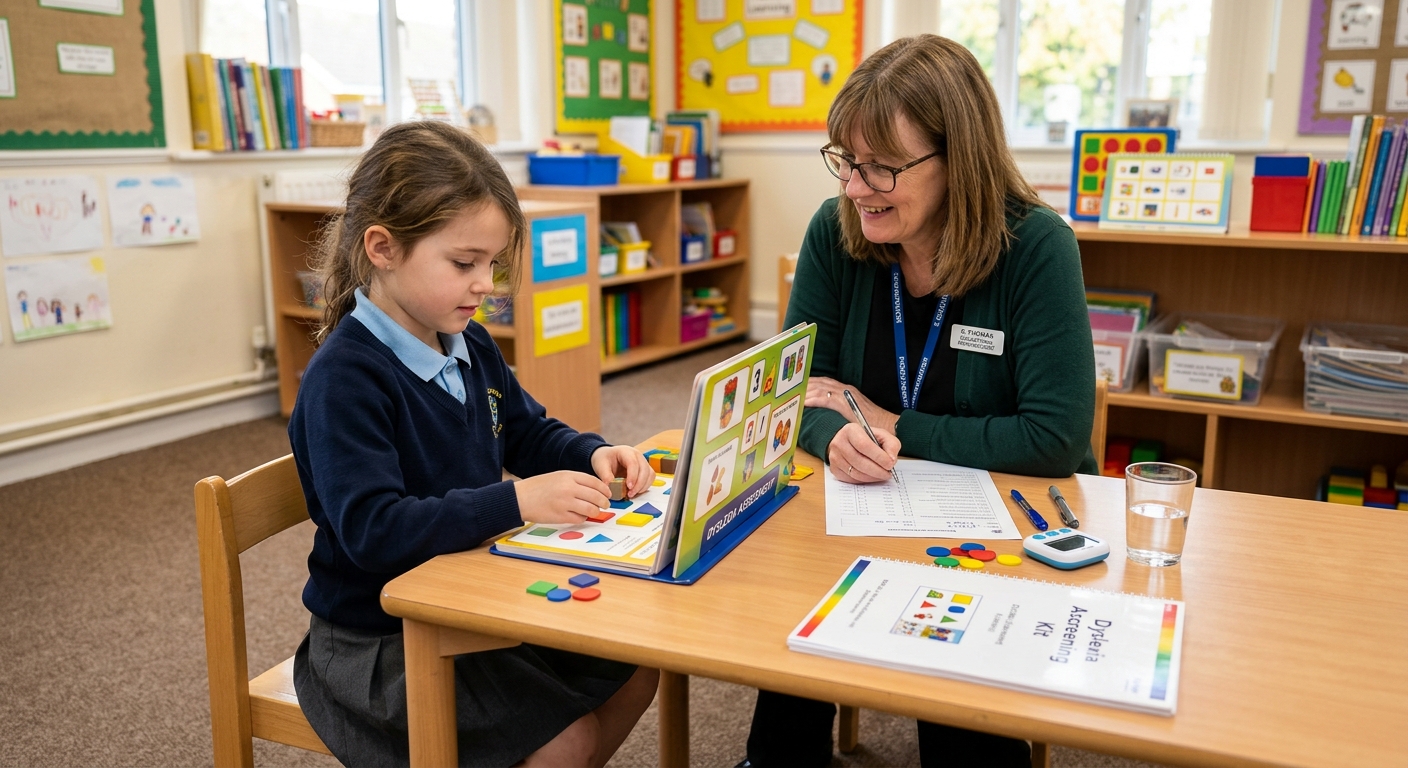
Dyslexia Diagnosis
Discovering the root cause of these struggles does not have to be a stressful ordeal. The most effective, time-tested way to gain clarity is through a structured, clear two-step process for dyslexia diagnosis.
By breaking the journey down into two distinct phases Screening and Formal Diagnostic Assessment you can save valuable time, cut unnecessary costs, and build a precise roadmap for support.
This comprehensive guide breaks down exactly how the two-step process works, what each step costs, the pros and cons of both, and precisely when to choose which route.
What is the Two-Step Process for Dyslexia Diagnosis?
The two-step approach is the gold standard framework recommended by educators and educational psychologists across the UK. Instead of jumping straight into a lengthy, expensive clinical evaluation, this method begins with an accessible check to see if your struggles match a dyslexic profile, before committing to a formal legal identification.
- Step One: Dyslexia Screening Test: A rapid, accessible evaluation designed to establish a “probability profile.” It determines whether there is a low, moderate, or high likelihood that your difficulties are caused by dyslexia.
- Step Two: Diagnostic Assessment: A rigorous, in-depth, one-on-one evaluation conducted face-to-face or via structured video platforms. This is the only mechanism that provides a formal, legally binding diagnosis of dyslexia.
Step 1: The Dyslexia Screening Test (The Early Indicator)
If you suspect that you or your child might be dyslexic, your absolute first step should always be a dyslexia screening test.
A screener does not give a definitive medical or legal label. Instead, think of it as a smoke alarm: it tells you if something is happening that requires closer inspection. It looks at the core cognitive markers of dyslexia, including phonological processing (how you process the sounds in words), working memory, and rapid naming speeds.
Where Can You Get a Screener?
- Through Your School: Many primary and secondary schools utilize internal screening software administered by the Special Educational Needs Coordinator (SENCo) to spot children who are slipping behind.
- External Private Providers: If you are an adult, an independent student, or a parent whose school is facing long delays, utilizing an established private screening partner is the fastest route to clarity. Specialized providers, such as the Indigo Dyslexia Centre, offer targeted, professional screening options that assess your specific cognitive habits and deliver a comprehensive probability breakdown.
The Pros of Dyslexia Screening
- Affordable Entry Point: Screenings cost a fraction of a full assessment, allowing you to check if you are on the right track before investing hundreds of pounds.
- Rapid Turnaround: Unlike clinical waiting lists that stretch on for months, a screening test can often be booked immediately or completed online in under two hours.
- Triggers Immediate School Support: Under the UK SEND Code of Practice, schools are legally required to provide support based on a child’s identified learning needs, not a formal medical diagnosis. A professional screener from a provider like the Indigo Dyslexia Centre provides solid, physical proof of a learning hitch, forcing schools to implement immediate classroom adjustments (like extra reading groups or assistive tech).
- No Age Barriers: Screening can capture early indicators in young children (7+) before reading gaps widen significantly.
The Cons of Dyslexia Screening
- Not a Formal Diagnosis: A screener provides a probability statement (e.g., “High Probability of Dyslexia”), not a formal diagnosis.
- Exam Accommodations: You cannot use a screening report to secure official Exam Access Arrangements (like 25% extra time, a reader, or a scribe) for GCSEs, A-Levels, or university exams.
Expected Costs for Step 1
- School Route: Free (covered by the school’s internal budget, though availability varies widely depending on resources).
- Private Providers / Specialised Centres: Typically ranges from £70 to £100, depending on whether it is an automated tool or an advanced screening.
Step 2: The Formal Diagnostic Assessment (The Gold Standard)
If your screening test returns a “moderate” or “high probability” of dyslexia, your next move is to step up to a full Diagnostic Assessment.
This is an exhaustive, personalized evaluation that takes between two and four hours. The assessor conducts a battery of up to ten sub-tests examining real-world reading speed, spelling accuracy, verbal reasoning, visual pattern recognition, and auditory processing.
Who Conducts It?
To ensure the resulting document holds legal and educational weight, it must be carried out by a highly regulated professional holding an Assessment Practising Certificate (APC). This means it must be done by:
The expert doesn’t just score tests; they piece together your historical background, school samples, and behavioural traits into a 20+ page diagnostic profile.
The Pros of a Diagnostic Assessment
- Definitive, Legal Proof: This is a lifelong, legally recognized document. It acts as an absolute verification of dyslexia under the Equality Act.
- Unlocks University & Workplace Funding: Vital for securing Disabled Students’ Allowance (DSA) funding for specialized laptops, software, and study coaches. In the workplace, it forces employers to provide “Reasonable Adjustments” to prevent career stagnation or unfair discrimination.
The Cons of a Diagnostic Assessment
- High Financial Cost: Because it requires hours of one-on-one expert time and intense report drafting, it represents a significant upfront investment.
- Mentally Draining: The testing process is demanding and can be thoroughly exhausting, particularly for younger children.
- Long Waiting Lists: Private assessors frequently book out months in advance, and Local Authority routes can take years.
Expected Costs for Step 2
- Specialist Teacher Assessor: Usually £600 (plus VAT where applicable).
- Educational Psychologist: Typically, £900+.
Side-by-Side Comparison: Screening vs. Diagnostic Assessment
To help you view the whole picture at a glance, here is how the two phases stack up across critical variables:
| Feature / Metric | Step 1: Dyslexia Screening Test | Step 2: Diagnostic Assessment |
| Primary Goal | Identify likelihood of dyslexia | Deliver definitive, legal confirmation |
| Who Conducts It? | School SENCo, or private screening centres | Certified Educational Psychologist or Specialist Teacher (APC) |
| Duration | 1 hour of testing | 3 to 4 hours of intensive testing |
| Average Cost | £0 to £120 | £450 to £900+ |
| Legal Standing | formal evidence of learning difficulty under SEND code of practice | Legally binding under the Equality Act |
| Best For | Starting school help | University funding, workplace protection |
When Should You Choose Step 1 vs. Step 2?
Understanding when to deploy each step saves you from overpaying for testing you don’t need, or getting caught without the right paperwork when an exam deadline hits.
When to Stick with Step 1 (Screening)
- You’re testing a young child: Use a screener to see if early interventions are working or needed.
- You want immediate support at school: If your child is struggling today and you need the teacher to modify homework assignments immediately, an affordable screening gives the school the proof they need to act under the Graduated Approach.
- You want to rule out dyslexia: If you suspect a learning struggle but aren’t sure, a screening that shows a “Low Probability” saves you from spending hundreds on a full assessment when the issue might actually be vision or hearing-related.
When to Graduate to Step 2 (Diagnostic Assessment)
- Heading to University: If you are preparing an application for the Disabled Students’ Allowance (DSA) to get technology or tutoring grants, a screening will be rejected. You must provide a full diagnostic report.
- Workplace disputes or professional exam hurdles: If you are an adult struggling to get your employer to accommodate your tracking difficulties, or if you are sitting professional licensing exams (like the accounting board exams), you need the legal leverage of a formal assessment.
Next Steps: How to Take Control of Your Learning Journey
Living with unidentified dyslexia means constantly burning double the cognitive energy just to keep up with everyone else. Embracing the two-step process allows you to figure out exactly where you stand without financial or emotional strain.
If the traits of dyslexia feel entirely too familiar to you or your child, do not let fear of the process keep you stalled. Begin exactly where you are supposed to: book a dyslexia screening test with a dedicated partner like the Indigo Dyslexia Centre. Let that initial data show you the shape of your learning profile, and use it to confidently decide if, when, and how you will step up to a full diagnosis.